
Your powder decides the filler. Not the price list.
Powder and granules do not behave the same way twice. Bulk density drifts with humidity, fine powder bridges in the hopper, flakes break under a screw. So we do not sell one machine in five sizes — we build two platforms: a 1–6 kg weigh filler for rigid containers and bags, and a 5–2500 g bottle line. Everything below is about choosing between them, and about why the number on the datasheet is not the number you will get until the material is tested.
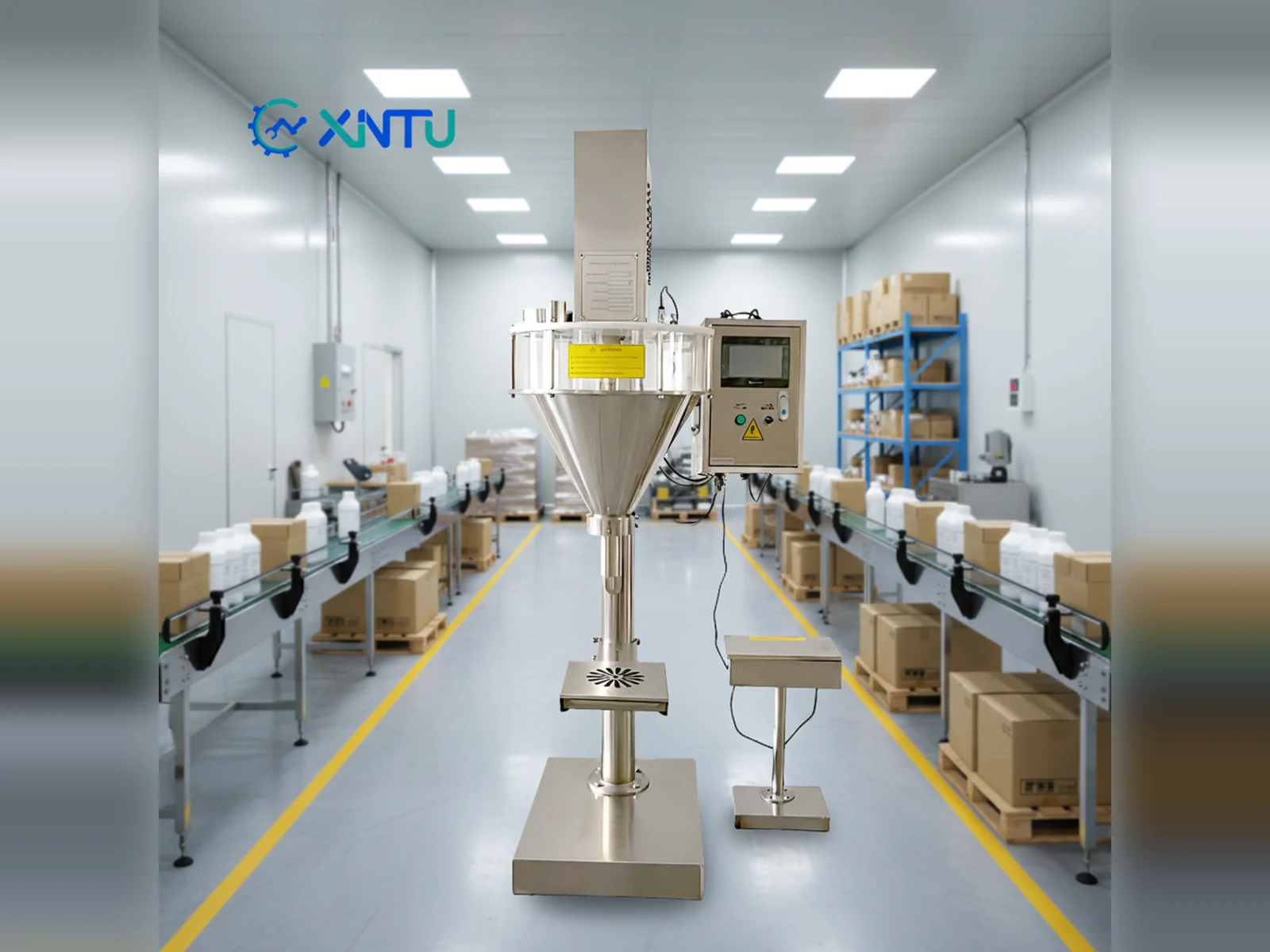
Container fill range, CFBW
Filled error, CFBW
Fills per minute, bottle line
Hopper volume, every model
Two platforms, five builds. Find your row.
Read the Dose column first, then Container. The split in this range is not price — it is what you are filling into. One platform weighs a kilogram-scale dose into a rigid container or a bag; the other indexes small bottles past a filling head at up to sixty a minute. Buyers who start from speed usually end up on the wrong side of that line.
- Do not compare the speed column across platforms. A CFBW fill is a kilogram; a BAF fill is a few grams. Twelve fills a minute at 6 kg moves more product than sixty fills a minute at 200 g.
- Every model uses SUS 304 for product-contact parts and a PLC with touch-screen HMI.
- CE / ISO documentation is issued with the machine; we do not certify third-party equipment.
One frame, two feeds. This is the machine most enquiries end on.
The CFBW is built around a 50 litre hopper and a stepper-driven auger, and it decides the dose by weight rather than by time. That single choice is why it holds ±0.3% while a purely volumetric filler drifts through the afternoon. Powder and granules share the frame — what changes is the feed and the discharge below the hopper.
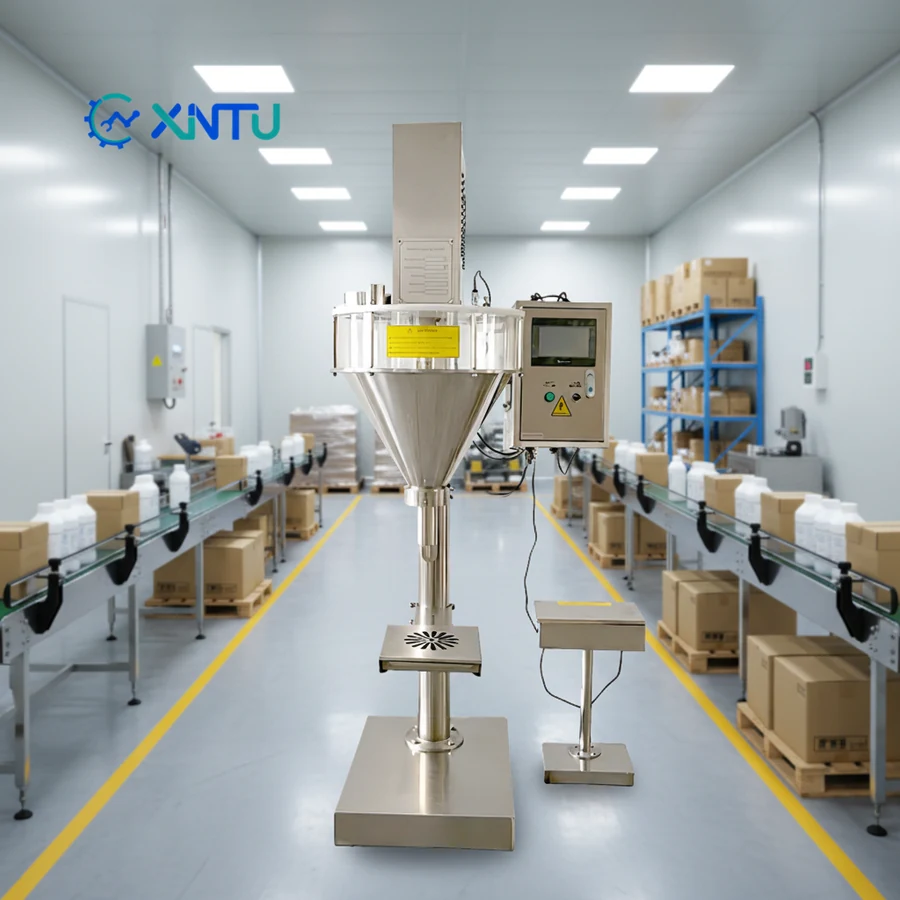
Fill-by-weight auger, rigid container
XINTU-CFBW 1–6 kgA screw inside a tube, driven by a stepper, drops powder into the container while a load cell watches the weight and stops the screw when the target is reached. There is no cup to change and no volume to re-machine when the recipe moves — you type a weight. That is the whole argument for this machine: when bulk density shifts, the dose still lands, because the controller is reading the result instead of predicting it.
Ask about this model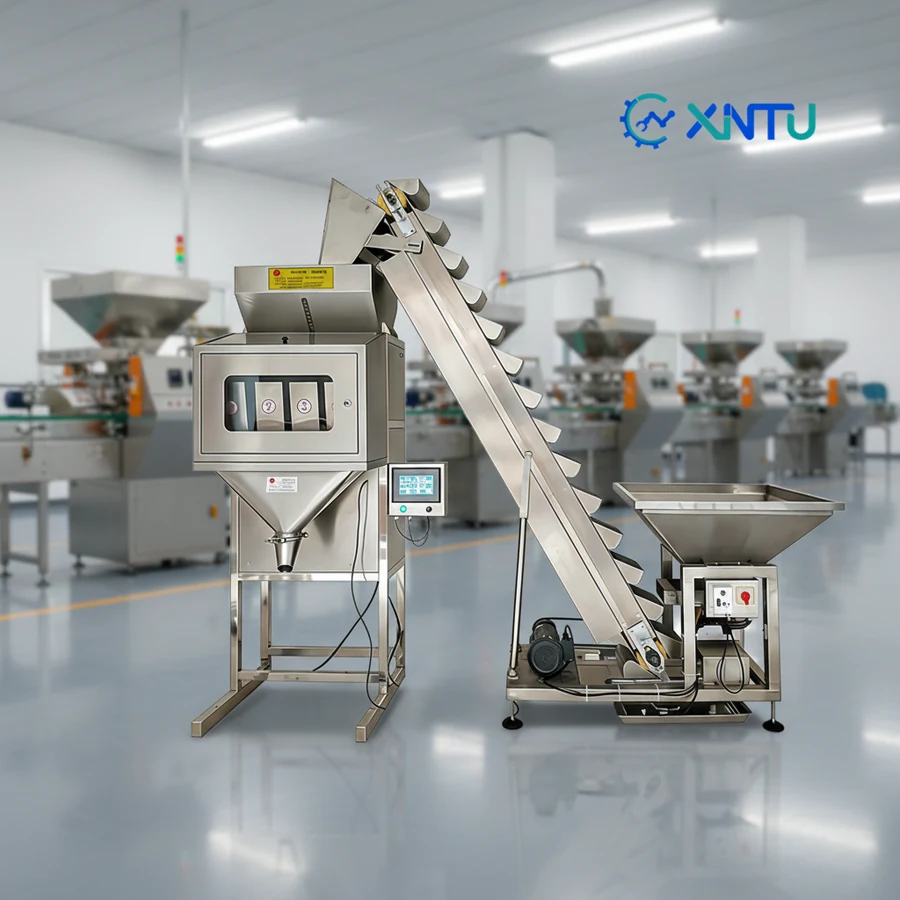
Same frame, granule feed
XINTU-CFBW · granule 5–50 kgGranules are not a powder with bigger particles. They jam, they bridge, and an auger will shear them. This build keeps the CFBW frame, hopper and control cabinet and changes what happens underneath: a feed that lets discrete product fall rather than be pushed. The quoted accuracy is a packed-weight figure — 99.7% — not a percentage of dose, because on a 25 kg bag those are different promises.
Ask about this model- Both builds ship on the same 800 × 800 mm footprint at 1960 mm high — a plant that starts on powder can add the granule build without re-planning the floor.
- Product-contact parts are SUS 304; the hopper is monitorable, so a low level is alarmed rather than discovered as an underweight fill.
- Photographs above are workshop shots of the machines as built — no renderings, no stock images.
When the dose is grams and the bottle is already standing.
The BAF range fills 5 to 2500 grams into bottles, jars and tins on an index. All three share a servo-driven auger, a 50 litre hopper, SUS 304 contact parts and a quoted error under 1%. They differ in how the containers are carried and how much guarding and access you get — which is a line-design question, not a filling question.
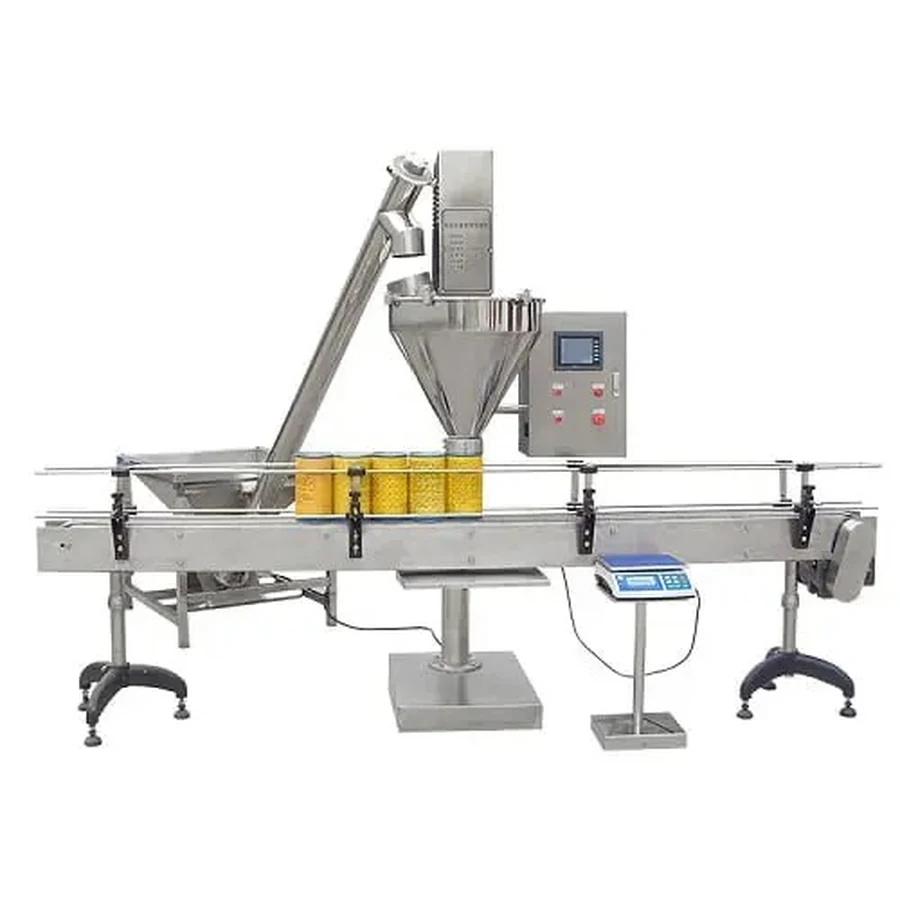
Linear index, economic build
XINTU-BAF-01 5–2500 gThe entry point to an indexed bottle line. Containers step past a single servo auger head on a linear index; the guard room is left out and the frame is the shortest of the three. It fills to the same tolerance as the rest of the range — what it does not give you is the enclosure.
Ask about this model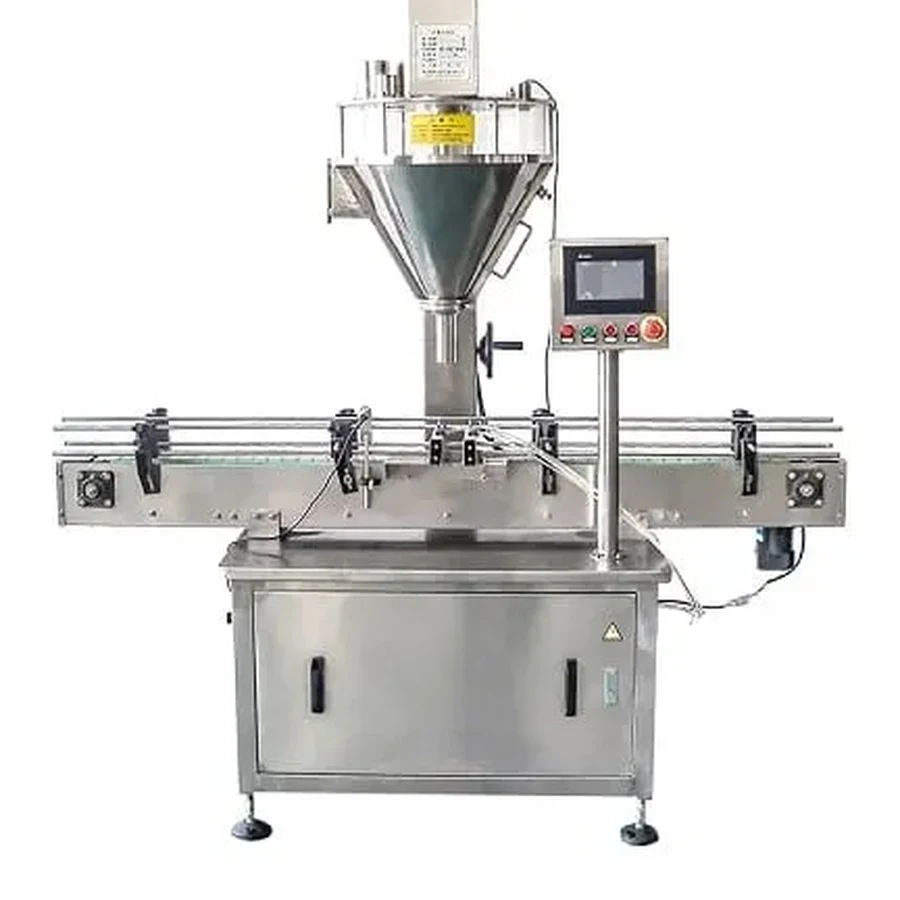
Linear, updated frame
XINTU-BAF-L 5–2500 gThe same linear principle with the things a production line actually asks for: an optional enclosure over the fill zone, height-adjustable auger, a monitorable hopper and an easy-clean one. Taller and heavier than the economic build, and specified when the room has to be closed around the product.
Ask about this model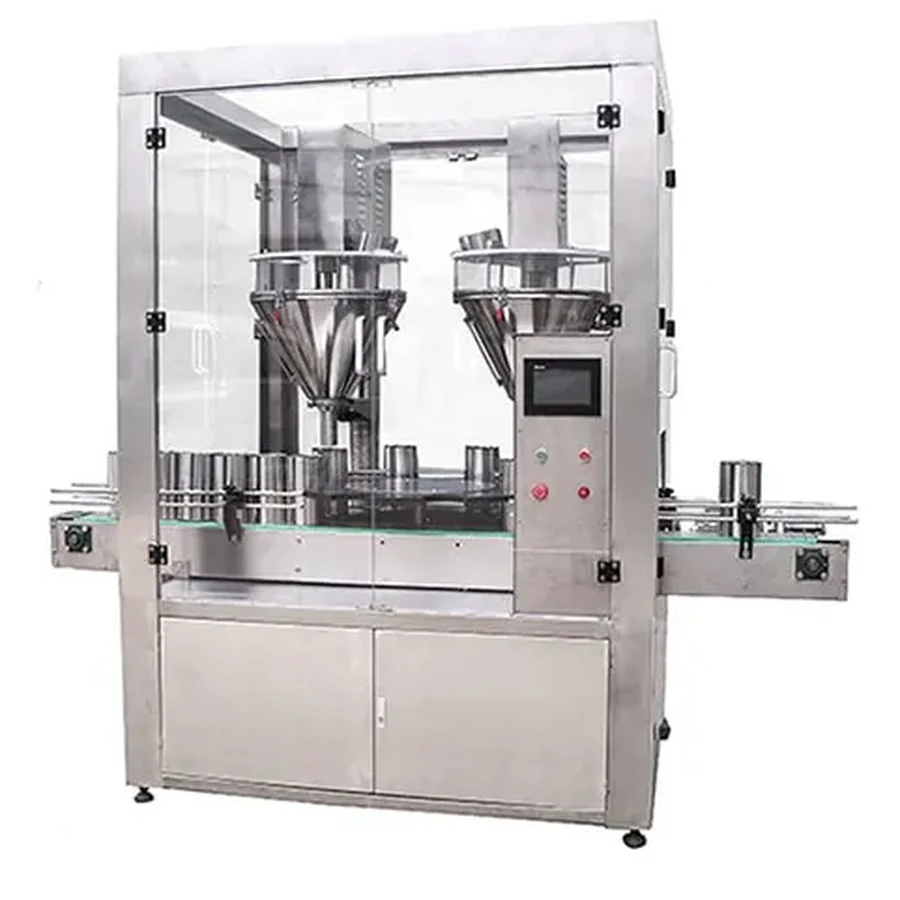
Rotary star-wheel
XINTU-BAF-R 5–2500 gContainers are carried on a star wheel instead of stepping along a lane, so the machine never waits for the index to settle. It is the heaviest build in the range at 550 kg, and it is the one to specify when the line upstream already delivers upright containers at a steady rate.
Ask about this modelWhy these three and not the rest of the catalogue: our own range runs to five BAF builds, including a dual-auger model and a fill-by-weight variant. Three of them fill the same bottles at the same tolerance and differ only in options, so putting all five on this page would ask you to compare footnotes. If your case actually needs two heads on one frame, say so in the enquiry — it is a real build, it is just not a different answer for most buyers.
Four ways to measure a dose. Only one suits your powder.
The expensive mistake in filling is not buying the wrong machine — it is buying the right machine with the wrong metering principle. All four methods below can hit a target weight on a good day. They fail in completely different places, and that is what you are really choosing between.
Auger, weigh closed-loop
Weight-based · XINTU-CFBWThe screw turns and a load cell watches the container. The dose ends on weight, not on time. Whatever the powder did to its bulk density this morning, the controller sees the number and stops there.
- Works when
- The dose is large enough for the cell to resolve cleanly — from roughly a kilogram upward.
- Fails when
- The target is a few grams; the cell cannot resolve it and the settling time kills the rate.
- Best for
- 1–6 kg powder into jars, cans, drums and bags. Flour, milk powder, starch, premix, additives.
Auger, servo-timed
Time-based · XINTU-BAF rangeA screw of fixed pitch turns for a set number of revolutions. At gram doses this is the fast, repeatable answer — and it is honest about its assumption: that the powder packs the flights the same way every cycle.
- Works when
- Bulk density is stable, the hopper stays in its working band, and the powder flows.
- Fails when
- Humidity moves, the hopper runs low, or the powder aerates — the screw then carries less than it did an hour ago.
- Best for
- 5–2500 g into bottles on an index. Seasoning, supplements, cosmetic powder, chemical additives.
Volumetric cup
Geometry-based · line optionA pocket of fixed volume rotates under the hopper, fills, and drops. No timing, no electronics in the dose path. Extremely repeatable — for exactly one bulk density.
- Works when
- The product is free-flowing and consistent and the recipe never changes.
- Fails when
- You change product or target weight — each change needs a new cup machined.
- Best for
- Rice, salt, refined sugar, beans, single-SKU high-volume runs.
Weigh hopper, bag by bag
Batch-based · CFBW granule setupThe whole bag is weighed, not the individual particle stream. Product falls into a hopper on load cells, the target is cut by weight, and the bag is released. This is why the accuracy is quoted as a packed-weight percentage rather than a dose error.
- Works when
- The bag is the selling unit and 5 to 50 kg goes in at once — grains, seeds, beans, pellets.
- Fails when
- The product is dusty or cohesive; it bridges above the gate and the batch starves.
- Best for
- Open-mouth bags on a short conveyor, 4 to 20 bags a minute, 99.7% packed weight.
How we actually choose for you: send 1–2 kg of the material and the target dose. We run it on the candidate head and send back the fill-weight spread across twenty fills — not a promise, a measurement. Bulk density, angle of repose and particle size settle the question faster than any specification table, and they are the three numbers most buyers do not have on hand.
Numbers, model by model.
Contact material, control platform and hopper volume are fixed across the range. Dose, accuracy, speed, footprint and power are set per model — and the figures below are the ones printed on the technical sheet, not catalogue rounding. Where a number is confirmed per order rather than fixed, the field says so.
What is fixed and what is not: the dose range, filled error, speed, hopper volume, power and dimensions above are the technical-sheet values and do not move with a standard order. What does move is the set-up inside those numbers — auger pitch, nozzle diameter and the speed you can actually run at all depend on the material and the container. Those are confirmed on the sample before the machine is built, and they are printed on the order acknowledgement.
What happens between two containers.
The cycle is short and it repeats a few thousand times a shift. Every one of these four steps is a place where accuracy is either kept or lost — which is why the machine is judged on the fourth one, not the first.
The screw fills
Product drops from the hopper into the auger flights. A low hopper fills the flights less densely than a full one — this is why hopper level is monitored rather than assumed.
The dose is cut
The screw stops on weight (CFBW) or on time (BAF). Either way the cut is the decision point: everything downstream is just transport.
The product falls
Powder drops through the nozzle into the container. Dust extraction and a sealed path keep the fill inside the target, and keep the workshop air clean.
The check
A checkweigher downstream — or a periodic manual sample — confirms the spread. If it drifts, the answer is in step 1, not in the screw speed.
- Changeover between products: hopper and auger lift out without tools on the BAF builds.
- Recipe recall from the HMI — no mechanical adjustment between SKUs on the same machine.
- Dust extraction is optional and strongly advised for fine powders; it is quoted with the filler.
What we need from your plant, and what you should check.
Almost every filling complaint that turns out not to be a machine fault is one of these six things. They cost nothing to check now and a lot to fix after the container lands.
APower
- CFBW — AC three-phase 380V 50Hz, 1.5 kW.
- BAF — three-phase 380V, 2.0 kW on the linear builds, 2.5 kW on the rotary.
- Earth — a load-cell machine needs a clean earth, not a shared one.
- Tell us the site voltage at the order stage; the motor is wound for it.
BAir
- BAF-01 and BAF-L are quoted at 25 L/min; the rotary build has no air circuit in the standard configuration.
- Dry, filtered compressed air at a stable pressure — moisture in the line reaches the powder before the machine does.
- CFBW needs air only if dust extraction is specified.
CMaterial
- Bulk density — the single most useful number you can send us.
- Particle size and flow — free-flowing, cohesive, or dusty.
- Sample — 1–2 kg is enough to run a real fill test across twenty fills.
DContainer
- Jar, can, bottle, pouch or open-mouth bag — and the opening diameter.
- Height range, against the 800 mm nozzle clearance on CFBW.
- Whether it is presented empty, nested, or already labelled.
ESpace
- CFBW is 800 × 800 mm on the floor and 1960 mm high; BAF-R is 2000 × 1000 × 2100 mm.
- Add 800 mm access on the hopper side for refilling and cleaning.
- Headroom to lift the hopper out, and a floor rated for the frame weight.
FEnvironment
- Humidity — the usual reason a volumetric dose drifts between morning and afternoon.
- Ambient temperature, if the product is heat-sensitive.
- Wash-down practice, if the area is cleaned wet.
Six answers and we can quote a model, not a range.
We do not send a price list and let you guess. Send the six items below and the reply names one machine, one configuration and one accuracy figure — normally within two working days.
- The product. What it is, and its bulk density in g/L if you have it.
- The dose. Target fill weight, and the tolerance you actually sell against.
- The container. Type, opening diameter, and height range.
- The output. Containers per minute or bags per shift, and how many shifts.
- The site. Voltage, phase, and whether compressed air is available at the machine position.
- The constraint. Floor space, budget ceiling, or a deadline — whichever is really driving this.
Between the hopper feeder and the checkweigher.
The filler is one station. What decides whether the line runs at rate is what happens on either side of it: an empty hopper stops the filler, and a filler that over-delivers stops the checkweigher. On a XINTU-CFBW the refill side is usually a screw conveyor or a Z-elevator into the 50 litre hopper; on a XINTU-BAF build the container feed is the constraint, because the filler itself will do sixty a minute.
- We build the filler to interface with the line you already have — send the drawing.
- Hopper refill can be manual, or fed by a screw conveyor or Z-elevator.
- Downstream checkweighing is the lower-cost way to prove the fill, and we will quote it with the filler.
The ones that come up before every order.
Can one machine fill both powder and granules?
On the CFBW platform, yes — because it is the same 800 × 800 mm frame, hopper and control cabinet, and what changes is the feed and discharge below the hopper. That is why both builds are listed under one model number. On the BAF bottle line, no: a screw that meters powder will shear granules, and converting the machine is not an option we offer. If you need both into bottles, the honest answer is two heads on one frame, or two machines.
My powder is very fine and dusty. Will it work?
It will, with two additions: dust extraction at the nozzle, and a sealed product path. Fine powder also aerates in the hopper, which makes a purely volumetric dose read light until it settles. For fine powders we normally steer you to the CFBW — the weigh closed-loop build — because it reads the result instead of predicting it.
What accuracy can I actually expect?
Three different numbers, and they do not mean the same thing. The CFBW is quoted at ±0.3% of the dose on a 1–6 kg fill — about 18 g on a 6 kg pack. The BAF bottle line is quoted under 1% across 5–2500 g, because gram doses are harder to hold as a percentage. The granule setup is quoted at 99.7% packed weight, which is a bag-level figure, not a dose error. What your material actually does is confirmed on a fill test and printed on the specification sheet.
How long does changeover take?
On the BAF builds the hopper and auger lift out without tools, and the recipe is recalled from the HMI. On the CFBW the hopper is monitorable and the auger assembly is a tool-free lift as well. The mechanical work is minutes; the cleaning is what takes the time, and that is set by your hygiene standard, not by the machine.
Do you supply CE / ISO documentation?
Yes, with the machine. We do not certify a line built by someone else, and we will not describe a third-party component as certified by us.
What is the lead time?
It is quoted against the confirmed configuration — model, contact material, dust extraction, feeding method and voltage. A catalogue model number alone is not enough to schedule a build, so we confirm the configuration first and then commit to a date. XINTU-BAF-R carries the longest path of the bottle builds, because the star wheel is machined against your container diameter rather than set from a table.
Tell us the powder. We will tell you the filler.
Bulk density, target dose, container and output — four lines in an email is enough for us to name a model and a configuration instead of sending you a catalogue.