
Palletizers sized by your case, not our catalogue
Two ways to automate the last five metres: a collaborative arm that usually needs no fence, and a column palletizer that builds a whole tier at a time. Ten cobot models from 20 to 50 kg, matched to the stack height and pallet size you actually run — and both built in our own plant, so the cell, the gripper and the layout come from one source.
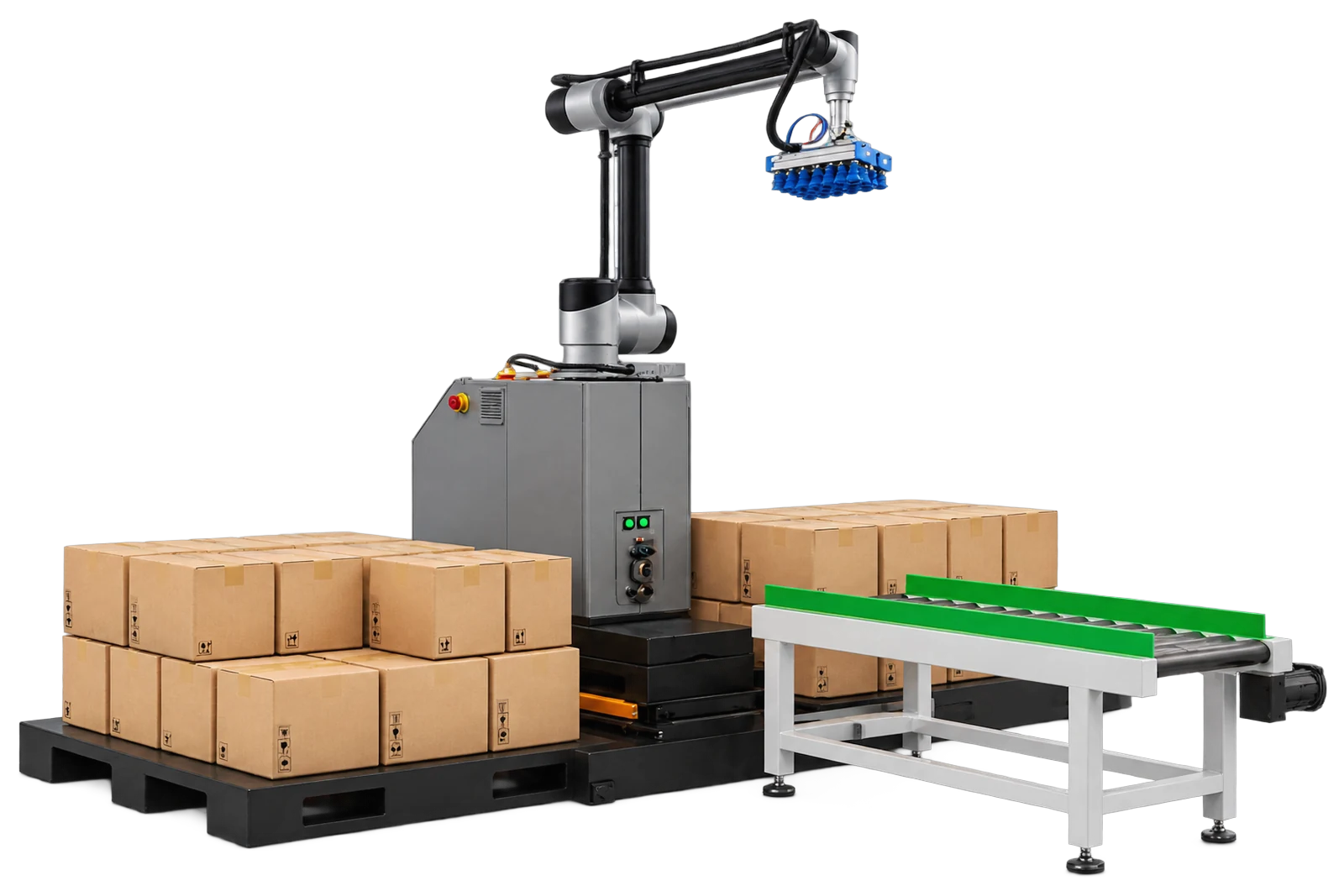
Palletizer types:
cobot and column
Fastest type, cases
per minute (column)
Heaviest payload,
kg (XT-CRP50)
Tallest finished
stack, mm (XT-CRPC30)
Two types, and the rate you need picks for you
The two bands barely overlap: a column palletizer runs 25–40 cases a minute, a cobot 8–12. Below about 12 cases a minute a column machine is capacity you will not use; above 25, no cobot cell keeps up, whatever the gripper. Read the row that matches your sustained rate, then check payload and stack height.
Cobot figures are from our own datasheet for the XT-CRP series — ten models, one row each below. Column figures are the published band for the CE-certified column family; the exact rate depends on your case size and pattern, and we size it from your sample.
Same job, two different safety models
A cobot is not simply a slow robot — it is a different safety model, and that is what makes retrofits possible without rebuilding the line. A column palletizer is not a fast robot either: it builds a whole tier before it lifts. The type decides the guarding, the floor space and the changeover routine, long before price enters the conversation.
Collaborative Robot Palletizer
Force-sensing arm, 8–12 cases/min, retrofits into a corner
- Force-sensing arm stops or slows when a person enters the working area
- Often installed without a fence, subject to the site risk assessment
- Runs on single-phase 220 V — no three-phase supply needed
- Pallet patterns edited on the touchscreen in about two minutes
- Smallest footprint of the two; fits an existing line end
Column & Layer Palletizer
Builds a whole layer, then places it — 25–40 cases/min
- Builds a complete layer, then sets it with a row pusher or fork
- Roughly three times the cobot’s rate on the same case
- Needs a pattern-forming station and two pallet positions of floor space
- Best on one or two case sizes with few pattern changes per shift
- CE certified under MD 2006/42/EC as a column palletizer
What each type does at the end of your line
Both take cases from an infeed conveyor and place them on a pallet. What changes is how many cases move per cycle, what the guarding looks like, and how much floor the cell needs around it.
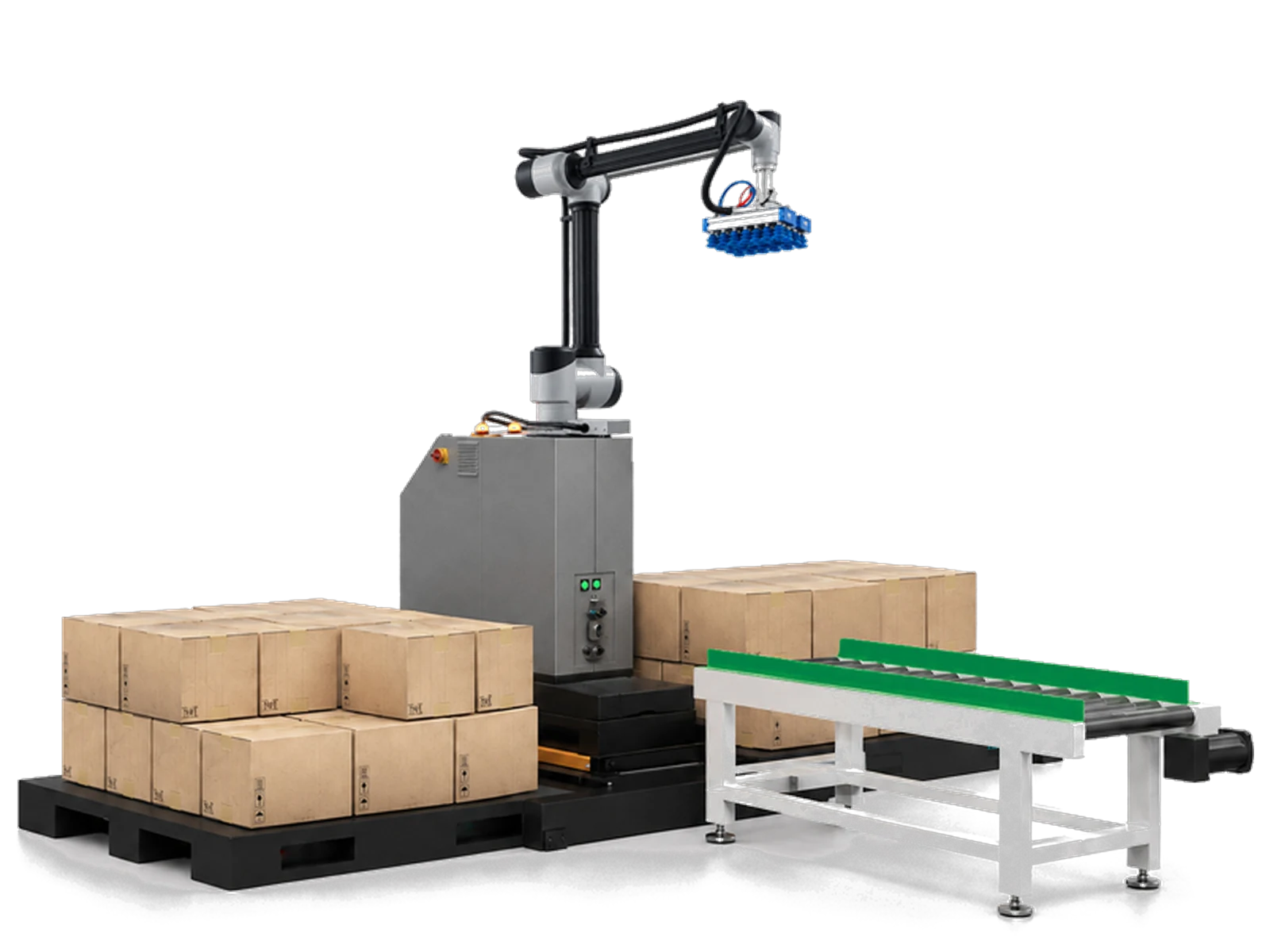
Collaborative Robot Palletizer — XT-CRP series
The cobot cell is the one that fits into a plant that already exists. Because the arm senses force, it can slow or stop when a person enters the working area, so in many installations the fence disappears and with it the floor space and the civil works. Ten models cover 20 to 50 kg of payload and stacks from 2000 to 3000 mm — the differences are reach and lift, not software.
- Single vacuum gripper with a check valve per cup, so a smaller case still seals even when some cups overhang
- Vacuum verified against a threshold on every pick — a bad pick alarms before the case travels
- Two pallet positions: stacking continues on one side while the finished pallet is exchanged on the other
- Up to 255 stored recipes, two case types at once, four patterns per pallet, about two minutes per changeover
- Single-phase 220 V and 0.5–0.7 MPa air — no three-phase supply to bring in
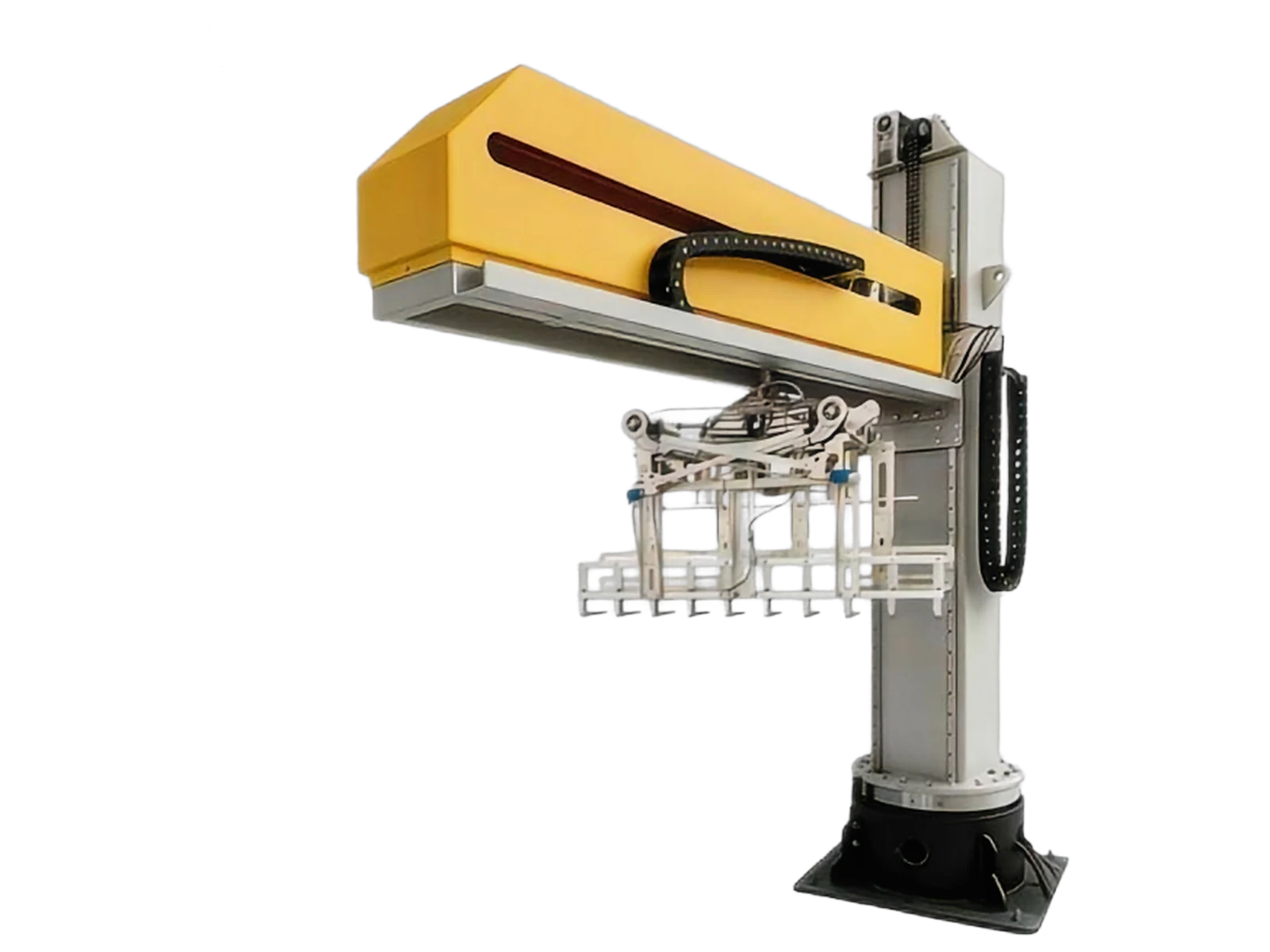
Column & Layer Palletizer — CPM / CP series
The column palletizer does not pick cases one at a time. It forms a complete tier on a pattern-forming station, lifts it on a vertical mast, then sets the whole tier with a row pusher or fork — which is why it reaches 25–40 cases a minute while a cobot cell cannot. It is also the less flexible of the two: one or two case sizes, few pattern changes, and a mechanical pattern change when they do happen. In exchange, cost per case is the lowest of any option here.
- Builds a full layer, then places it — roughly three times the cobot’s rate on the same case
- CE certified to MD 2006/42/EC as a column palletizer, with the certificate on file
- Best on one or two SKUs with stable patterns and three-shift running
- Needs a pattern-forming station plus two pallet positions of floor space
- Mechanical pattern change is slower than on a cobot — plan for fewer changes
Ten cobot models, one row each
Every figure below is from our own datasheet for that model, and every model is built in our plant. Payload already includes the gripper and mounting hardware — the net weight left for a filled case is the rated payload minus about 2.5 kg of tooling. Where a figure is not specified we leave it out rather than estimate.
| ModelXINTU code | Stack reachHow height is gained | Payloadincl. tooling | Working radiusmm | Working cyclepcs / min | Max stackmm | Max palletmm |
|---|---|---|---|---|---|---|
| XT-CRP20 | extended arm | 20 kg | 1880 mm | ≤ 12 | 2000 mm | 1300 × 1200 |
| XT-CRP30 | arm + lift | 30 kg | 1680 mm | ≤ 10 | 2350 mm | 1200 × 1000 |
| XT-CRPS30 | arm + lift | 30 kg | 1480 mm | ≤ 10 | 2150 mm | 1000 × 800 |
| XT-CRPL30 | arm + lift | 25 kg | 1880 mm | ≤ 12 | 2550 mm | 1300 × 1200 |
| XT-CRPXL20 | arm + lift | 20 kg | 2080 mm | ≤ 12 | 2750 mm | 1400 × 1200 |
| XT-CRP50 | arm + lift | 50 kg | 1780 mm | ≤ 6 | 2450 mm | 1200 × 1100 |
| XT-CRPS50 | arm + lift | 50 kg | 1580 mm | ≤ 6 | 2250 mm | 1200 × 900 |
| XT-CRPL50 | arm + lift | 45 kg | 1980 mm | ≤ 6 | 2650 mm | 1300 × 1200 |
| XT-CRPXL40 | arm + lift | 40 kg | 2180 mm | ≤ 6 | 2850 mm | 1400 × 1200 |
| XT-CRPC30 | arm + lift | 30 kg | 2380 mm | ≤ 6 | 3000 mm | 1750 × 1750 |
- Power — single-phase 220 V ±10%, 50/60 Hz
- Air — 0.5–0.7 MPa, roughly 240–460 L/min at the gripper
- Ambient — 0–50 °C operating temperature
- Gripper — single vacuum head with a check valve per cup; no head change between case sizes
- Recipes — up to 255 stored patterns, two case types at once, four patterns per pallet
From case size to a running cell
Palletizing projects fail on the risk assessment and the gripper, not on the robot. So we settle both before any model code gets quoted.
Case and pattern audit
You send the smallest, largest and typical case, plus the pallet pattern you want. We check weight, surface finish and overhang before anything else.
Type and safety concept
Cobot or column palletizer, chosen by sustained rate and payload. The safety concept comes with the technical offer — not after the purchase order.
Cell layout and utilities
Infeed direction, both pallet positions, safety clearances, pallet-jack access, floor anchoring and power on one dimensioned drawing.
FAT, install, train
Run on your own cases at our factory, then installation, pattern training on the touchscreen and a spare gripper cup set on site.
Six answers, and we can size the cell
No specification document needed. These six answers are enough to pick between the two types and give you a throughput estimate you can check.
- Case size and weightSmallest, largest and typical — and the weight range filled
- Sustained rateCases per minute you need hour after hour, plus the peak
- Pallet and patternPallet size, pattern drawing, maximum stack height including the pallet
- Case surfacePrinted, waxed, shrink-wrapped or dusty — this decides the gripper
- Floor and infeedAvailable space, infeed conveyor height and direction, operator access path
- DownstreamStretch wrapper, labeller or pallet conveyor — and how the full pallet leaves
The single most useful thing you can send is three real cases — smallest, largest and typical, with the weight each one runs at. Case dimensions on paper and cases coming off a packer are rarely the same thing: board bulges, the seal adds a few millimetres, and a wrapped case slides differently from a printed one.
Tell us the sustained rate you need hour after hour, not the peak. That single figure decides between the cobot and the column machine before anything else is discussed — and if the honest answer is that a cobot covers your volume, we will say so rather than quote the bigger cell.
The palletizer is the last machine, and the first bottleneck
Everything upstream can be automated, but if the end of the line is still people stacking boxes, that is where your capacity is set. Manual palletizing caps out around 6–8 cases a minute across a shift — and that average includes the last hour, when the pace drops.
The six things buyers ask before signing
Rate, stack height, patterns, pallet changes, failed picks and services. If your question is not here, send it — the answer usually changes the layout, so it is worth asking early.
How many cases per minute can you actually guarantee?
Rated steady-state output is up to 12 cases/min on the 20 kg model, 10–12 on the 30 kg models and up to 6 on the 50 kg models, based on a standard filled case within the rated payload and a standard stack height. Real throughput depends on case size, weight and pattern. Case rotation and pallet changeover are layout-dependent and are not counted in the per-minute figure; placing slip-sheets does reduce it, in proportion to the number of sheets per pallet. Normal safety settings do not reduce the rated speed.
What is the maximum finished pallet height, including the wooden pallet?
It depends on the model — the range runs from 2000 mm on the standard XT-CRP20 to 3000 mm on the XT-CRPC30. The standard XT-CRP20 is supplied without a lifting column: taller stacks are reached by extending the arm rather than adding a column, and extending the arm reduces the usable payload by roughly 5 kg. The robot reaches every position on both the bottom and the top layer.
Can our own operators create and save pallet patterns?
Yes, on the touchscreen — rotated cases, alternating layers, outward-facing labels, no overhang, and a partial final layer. Once each SKU program is saved, changing product takes about two minutes. The controller supports two case types palletized at once, up to four patterns per pallet and up to 255 stored recipes. Adding a new product or pattern is free of charge while recipe storage has capacity.
Can it keep stacking on one pallet while we change the other?
Yes. The robot continues on one pallet position while an operator safely removes and replaces the finished pallet on the other side, so pallet changes do not stop the line. Both positions are covered by the same risk assessment, and the operator’s access path is part of the layout drawing we supply with the project.
What happens if a case is picked badly or the air supply drops?
Vacuum monitoring is switched on at the touchscreen. On every pick the controller compares the vacuum gauge against a threshold you set; if it is below threshold an alarm triggers while the arm travels from the pick point to the pallet, and after a short vacuum build-up window the arm stops. A failed pick, dropping suction, or loss of compressed air or electrical power all alarm and stop the machine rather than dropping the case.
Do we need a fence, and what power and air does it need?
A fence is decided by the risk assessment, not by the machine type — many cobot installations run fence-free with a safety scanner and reduced-speed zones, while a column palletizer normally has a fixed guard around the layer-forming area. Utilities are single-phase 220 V ±10%, 50/60 Hz, and 0.5–0.7 MPa air at roughly 240–460 L/min. Operating ambient temperature is 0–50 °C. A dimensioned layout showing the conveyor, both pallet positions, safety clearances, pallet-jack access and floor anchoring comes with the project drawing.
Tell us the case and the pallet. We will name the model.
Cobot or column palletizer — the choice follows from your sustained rate and case weight, and we will say so plainly if the answer is the smaller of the two.