
One unit reaches. The other lifts. Neither finishes the job alone.
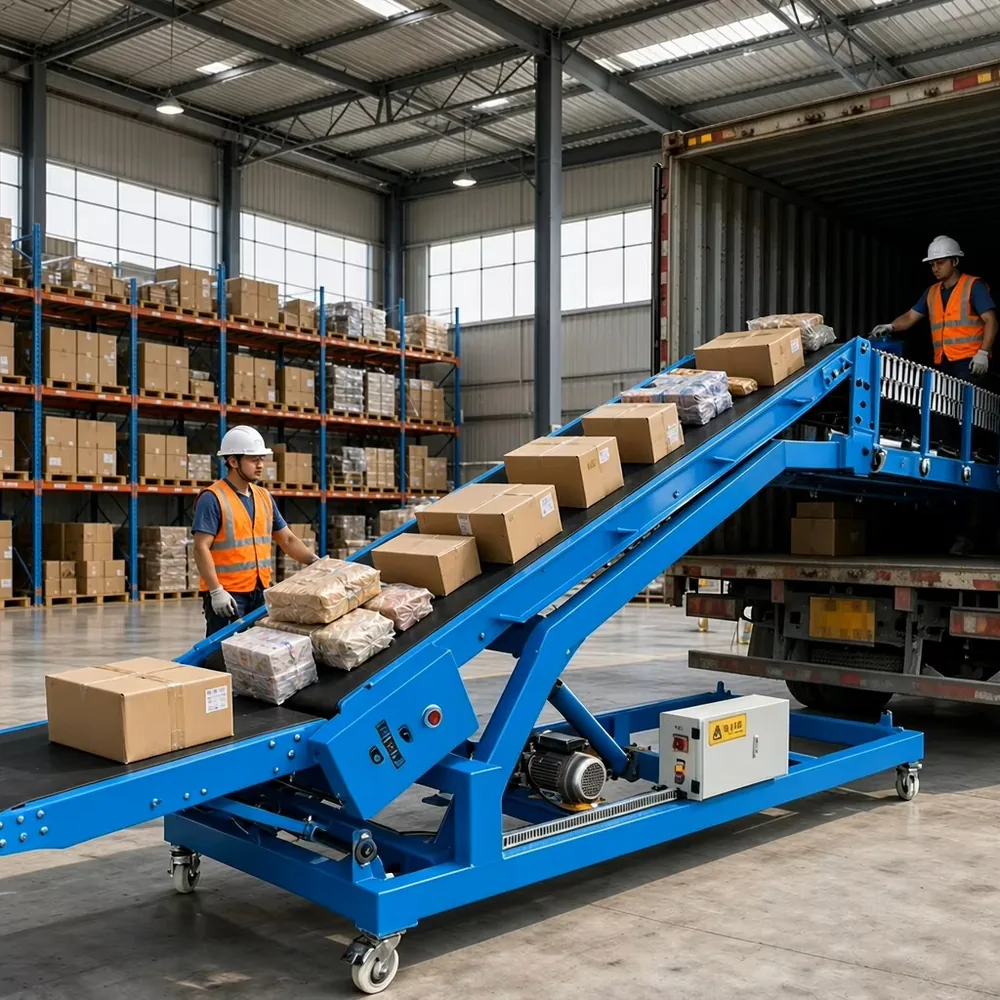
Loading a container from a fixed dock is two jobs that look like one. Something has to reach from wherever the cartons are released to wherever the load has stopped — and that distance changes with every trailer. Then something has to lift them from dock level up to the container floor and carry them in. XINTU builds those as two units that work as one system: a belt loading machine at 4,000 mm with a 800 mm belt and a discharge height up to 2,399 mm, fed by an extensible roller machine that runs from 3,800 mm out to 10,000 mm. Everything below is about which of the two you are short of — and the four measurements that decide the pairing.
Maximum roller extension
Belt loader length, 3 + 1 m
Maximum discharge height
Belt and roller face width
They are not two models of the same thing. They do different jobs.
The belt loading machine is the powered, inclined unit that takes cartons from dock height and carries them up and into the container. The extensible roller machine is the flexible run that reaches from wherever the cartons are released — a packer, a sealing line, a staging area — to the foot of the loader, and collapses back to 3,800 mm when the bay is needed for something else. Read the Job column first. If your problem is distance, you need the roller. If it is height, you need the loader. Most container bays need both, which is why they are quoted together.
- The handover is the part that gets specified wrong. The roller runs at 600–800 mm and the loader is built to sit at the container mouth at 983–2,399 mm. Those two heights are set independently — the roller on its adjustable sleeve legs, the loader on its hydraulic lift — and trimmed on site against your actual dock. Send both heights and we will match them at quotation instead of leaving it to the install.
- Both units are carbon steel (Baosteel / Shougang / Ansteel stock) on ≥T3.2 Q345 stamped frame plate. The loader is finished in blue, the roller is galvanised — that difference is a finish choice, not a build-quality difference.
- Both run on 220 V with a TaiBang inverter and an emergency stop inside the control box. They are separate electrical units, so one can be isolated and serviced while the other keeps running.
Same steel, same voltage, same control logic. Different job.

Belt loading machine
The unit that goes to the container and puts the carton inside it
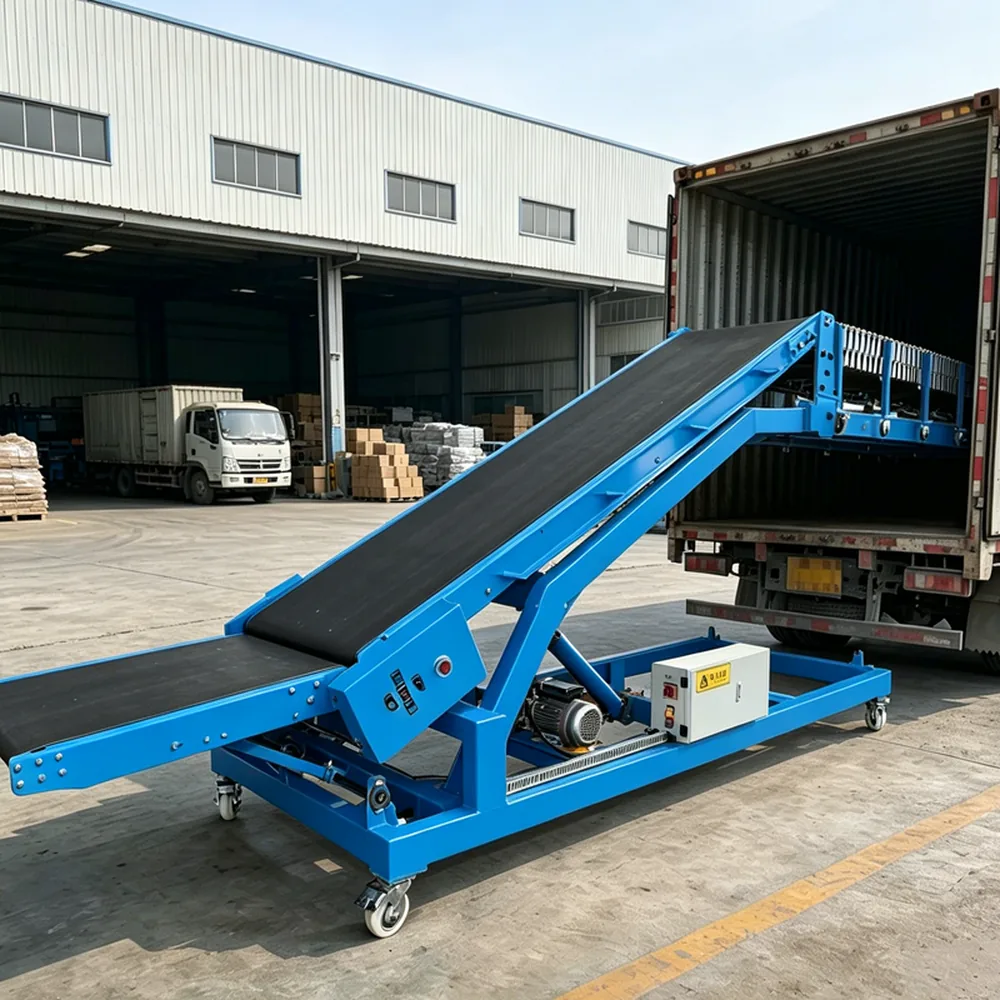
A 4,000 mm frame — 3 m + 1 m — carrying an 800 mm belt at 5 mm thickness, with the discharge end lifting on hydraulics through 983–2,399 mm. That range is the whole point: the belt has to arrive level with a container floor that sits far above your dock, and it has to do it with the carton still upright and still square. A 1.5 kW motor drives the belt and a separate 1.5 kW hydraulic unit works the lift, both reversible.

Extensible roller machine
The run that reaches the loader, then folds away
A roller bed that stores at 3,800 mm and extends to 10,000 mm — 6.2 m of travel, which is the difference between a fixed run that blocks the aisle and a run you pull out only when a trailer is at the bay. Rollers are Ø50 mm on a Ø12 mm shaft, 800 mm long in a ≈970 mm machine, driving through a poly-V belt and a geared motor. 200 kg per section, which is more than twice the loader’s rating — deliberately, so the roller section is never the bottleneck.
- In use the roller section is only as long as the trailer in front of it: it stores at 3,800 mm and runs out to 10,000 mm, so the aisle is blocked only while a vehicle is actually being loaded.
Six assemblies across the two units. Each one is a line on the quotation.
A container loading system looks like a frame with a belt on one end and rollers on the other, and that is roughly what it is — which is why the specification argument has to happen at the assembly level. Two systems can quote the same overall length and still differ by a factor of two in what happens after eighteen months of dock use. These are the six assemblies we quote separately.
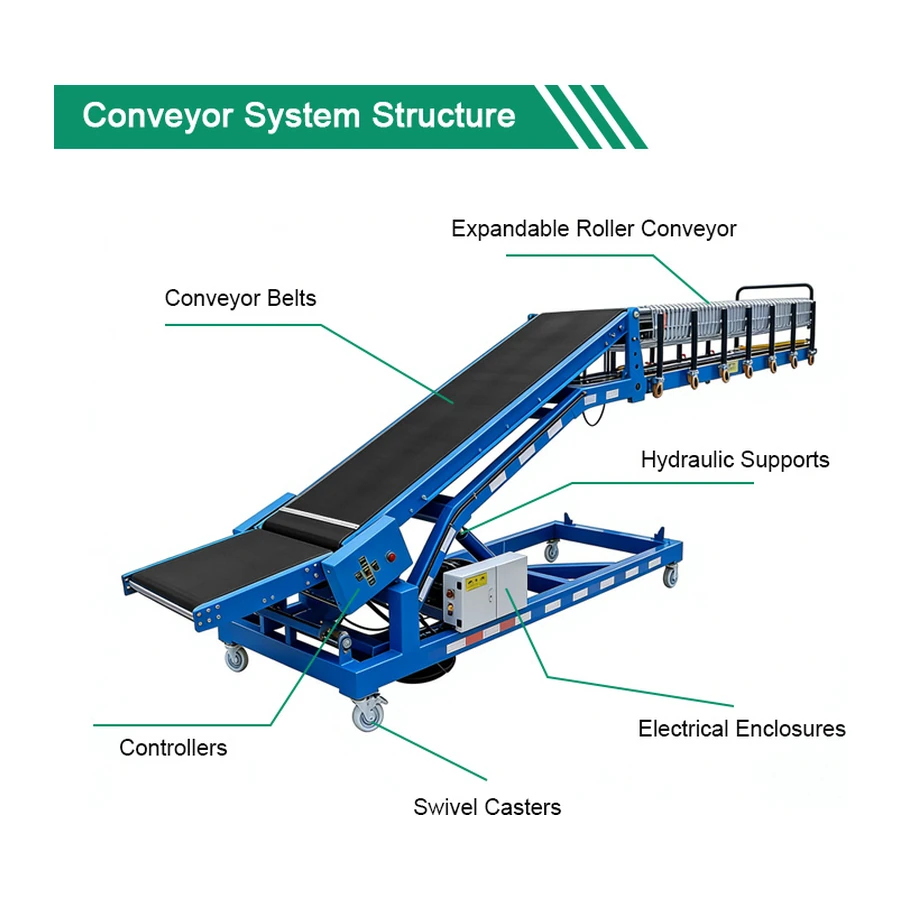
Conveyor belts
The load surface of the loader. 800 mm wide, 5 mm thick, running on the 4,000 mm frame. Belt width is what decides whether a carton travels square or drifts into the side rail, so it is set against your widest carton, not your average one.
Expandable roller conveyor
The telescopic nest on the roller unit — 3,800 mm closed, 10,000 mm open. Successive sections ride on the one below, so the extended run is supported along its whole length rather than cantilevered from the end. This is the assembly that decides whether the machine still tracks straight after a year of being pulled in and out.
Hydraulic supports
The 983–2,399 mm lift on the loader, driven by its own 1.5 kW hydraulic unit. On a container bay this is not a convenience — the trailer floor sits well above the dock, and the belt has to meet it at whatever height that turns out to be on the day.
Electrical enclosures
One cabinet per unit, wired to national standard, with insulated entry and exit openings and earth fault protection on the power cables. Two cabinets rather than one is deliberate: the loader and the roller can be isolated separately, so a fault on one does not stop the other.
Swivel casters
Castors with full brakes on both units, so each is repositioned by one person rather than by a pallet truck. Brakes matter more than the casters: an unbraked unit on a smooth dock floor drifts under load, and the drift is always towards the gap.
Controllers
TaiBang inverter per unit, one emergency stop per unit mounted inside the control box, and a spare parts kit fitted to the machine. Forward and reverse on both, so a carton that arrives the wrong way up can be walked back without unloading the run.
- The frame on both units is ≥T3.2 Q345 stamped steel plate, from Baosteel, Shougang or Ansteel stock. On the roller unit the transmission-roller connection plates are ≥5 mm, because that is where the load transfers into the telescopic sections.
- Rollers are zinc / magnesium / aluminium treated, ≥1.5 mm wall. That treatment is not cosmetic — it is what stops a roller seizing at the point where a wet carton sits overnight.
Numbers, unit by unit.
These are the design parameters for the standard build of each unit, from the drawing tables. Anything that is set per order rather than fixed — caster size, colour batch, container interface — says so in the field. Both tables carry one code at the top: customs code 8428330000 for the combined system.
Both units: ≥T3.2 Q345 frame plate, carbon steel from Baosteel / Shougang / Ansteel, national-standard cabinets with insulated cable entries and earth fault protection, one emergency stop per unit, one spare parts kit fitted, 1 year warranty. Packing is PE film and cushioning inside an export iron frame. Caster size is built to the load-bearing requirement of your layout rather than fixed, and colour is matched by batch — so the quotation, not this table, is the binding document.
Where the handover actually happens.
This is not a machine cycle — the two units are independent and nothing is interlocked. It is the sequence the operator repeats every time a container is loaded, and every one of these five moves is a place where the wrong pairing turns into manual lifting.
The container is spotted
The vehicle backs onto the bay. If the stop mark moves between drivers, this is already the moment the roller extension has to be variable rather than fixed.
The loader is raised
The discharge end comes up on the hydraulic unit through 983–2,399 mm until the belt is level with the container floor. A step here is a lift on every carton that follows.
The roller is run out
The extensible section goes from 3,800 mm towards 10,000 mm until it meets the foot of the loader. This is the move a fixed run cannot make — it is also why the unit stores short.
The two heights are trimmed
Roller legs at 600–800 mm, loader belt at container floor height, until a carton crosses the joint without a lip. Both brakes down before the first carton — an unbraked unit walks under load, and on a dock it walks towards the gap.
Both run together
Roller feeds, belt carries. Because the two are separately powered and separately reversible, a carton that jams at the handover can be walked back on one unit without stopping the other.
- The roller is rated 200 kg per section against the loader’s 80 kg per metre. That is deliberate: the reach section should never be what limits the throughput of the unit that follows it.
- Both units are reversible, so the same system loads and unloads. On an unloading job the belt runs the other way and the roller becomes the accumulation buffer at the dock.
- Nothing between the two is mechanically interlocked. They are two machines that happen to be next to each other — which is also why either can be bought, run or serviced on its own.
Four measurements, and the pairing is decided.
Almost every system that turns out to be the wrong one was ordered from a length alone. These four numbers cost nothing to take now and a lot to fix after the frame is cut — and they are the four we will ask for before we quote.
AThe gap you have to cross
- Shortest and longest distance from where cartons are released to the container mouth.
- Over 10,000 mm and the run needs a second roller section, or the layout needs moving.
- Whether the container is always spotted to the same mark — this sets how much extension you actually use.
BThe floor
- Level or not — a sloped apron changes where the roller legs end up.
- Surface: smooth concrete lets a braked caster hold; a rough joint will not.
- Aisle width where the roller is stored when the bay is needed for something else.
CThe carton
- Weight per carton — checked against 80 kg/m on the belt and 200 kg/section on the rollers.
- Width against the 800 mm belt: the belt decides whether it travels square.
- Base: flat and firm rides both surfaces; soft bags and nested trays need the belt, not the rollers.
DThe container and the dock
- Container floor height at your bay — the loader has to reach it within 2,399 mm.
- Whether the loader enters the trailer or stops at the mouth; this sets the frame length.
- Supply: 220 V at both units, and where the two cabinets will stand.
Six answers and we can quote a configuration, not a range.
We do not send a price list and let you guess which unit you need. Send the six items below and the reply names which of the two units you are short of, one configuration for it, and the dimensions that follow — normally within two working days.
- The gap. Shortest and longest distance from the release point to the container mouth.
- The container. Floor height at your bay, and whether the loader goes inside or stops at the mouth.
- The carton. Weight, width and what the bottom face is made of.
- The floor. Level or sloped, aisle width, and whether the roller stays out or is stored.
- The throughput. Cartons per hour you need to move, so we can size the belt speed and the drive.
- The constraint. Budget ceiling, voltage, or a deadline — whichever is really driving this.
Between the last machine and the container floor.
The system is the one station on the line with no cycle time of its own — it is the buffer between a line that runs at a fixed rate and a trailer that is loaded in bursts. What decides whether it works is what is on either side: a packer that releases cartons faster than an operator can walk them, and a container floor that sits well above the dock.
- We build the roller to couple with the machine you already have — send the drawing or a photo of the outfeed and we will match the infeed height.
- Two roller sections couple end to end where one 10,000 mm run is short of the release point. Tell us the total run and we quote it as a line, not as two machines.
- If the run has to go round a corner, tell us at the quotation stage — a curve is a different frame, not an option.
The ones that come up before every order.
Why is this two machines instead of one?
Because the two jobs have different shapes. Reaching is about length — it has to change as the trailer changes, which is a telescopic frame. Lifting is about height and grip — it has to carry a carton up an incline without it sliding back, which is a belt. One frame that tried to do both would be a compromise on each. Built as two units, each is sized against its own job, and either can be replaced, serviced or bought on its own.
Do I need both, or can I buy one of them?
One question answers it: what is between your cartons and the container? If the distance is already short and fixed, the belt loader alone does the job — that is the unit that lifts and carries in. If your containers are always spotted at the same mark and you only need the load brought to the loader, a single roller section may be enough. Most container bays need both, because the release point is fixed and the container is not.
How do the two heights line up?
Independently. The roller runs at 600–800 mm on adjustable sleeve legs; the loader’s discharge end works through 983–2,399 mm on hydraulics. That leaves a wide overlap rather than a fixed joint, and the actual mating height is trimmed on site against your dock. Send us both heights with the enquiry and we will set the legs and the lift travel to meet at quotation instead of leaving it to the install.
What does the 983–2,399 mm range actually cover?
It is the travel of the discharge end, from just under a metre to just under two and a half. That covers a container floor on a standard dock, and it covers the variation between a trailer that is loaded and one that is empty — the floor rises as the load goes in. A loader fixed at one height turns that variation into a step every carton has to be lifted over.
Why is the roller rated 200 kg when the belt is rated 80 kg?
Deliberately, and in that direction. The roller is the reach section — it should never be the thing that limits the unit behind it. Rating it at 200 kg per section against the belt’s 80 kg per metre means the bottleneck is always the belt, which is the unit you can hear and see, not the one twenty feet away.
Can it unload as well as load?
Yes. Both units are reversible — forward and reverse on the belt and on the roller drive. On an unloading job the belt runs the other way and the roller becomes the accumulation buffer at the dock. Because the two are separately powered and separately reversible, a carton that jams at the handover can be backed off on one unit without stopping the other.
What is the lead time, and what comes with it?
Lead time is quoted against the confirmed configuration — which unit or which pairing, belt and roller specification, caster size, container interface and voltage. A model number alone is not enough to schedule a build, so we confirm the configuration first and then commit to a date. Each shipment includes CE / ISO documentation, one spare parts kit fitted to the machine, PE film and cushioning inside an export iron frame, and a 1 year warranty on the complete system.
Tell us the gap. We will tell you which unit you are short of.
Shortest and longest distance to the container mouth, container floor height, and carton weight — three lines in an email is enough for us to name the pairing and the lengths instead of sending you a catalogue.