
Carton sealers built around the tape you already buy
Three tape patterns — top-and-bottom, full H-seal, and seal-plus-strap — across six models. Automatic flap folding on five of them, manual folding on the sixth for oversized cartons. Every model runs standard BOPP tape, so nothing changes on your consumables side.
Sealer models on one
tape and blade platform
Cartons per minute,
fastest model (FZ-544)
Longest fixed carton
envelope, mm (FZ855)
Widest tape used,
mm across the range
Six models, one question: how much tape does the carton need?
A single run of tape down the centre seam is a “one-strip” seal. Tape down the centre and around both end panels is an H-seal. Add a plastic strap and the carton stops needing tape to hold it shut at all. Read across the row, then follow the model code to its detail section.
- Output figures are the datasheet range — actual rate depends on carton size and board quality
- Model code links to the detail section below
- All models run AC 220/380 V, 50/60 Hz and standard BOPP tape
Three families, six models, one tape platform
Grouped by what the machine does with tape: a single run down the seam, four runs in an H pattern, or tape plus a plastic strap. The family tells you the seal; the model tells you the carton envelope.
H-Seal Carton Sealer
Centre seam plus both end panels, taped in one pass
- Four tape runs per carton — top seam, bottom seam and both end panels
- Automatic flap folding, so the operator only loads and unloads
- Largest single-pass carton envelope: up to 700 × 500 × 500 mm
- 1250 mm wide frame — the widest machine here, sized for loaded cartons
High-Speed Flap Folder
The smallest carton envelope and the highest rate
- Twice the throughput of the other flap folders — 15 to 30 cartons per minute
- Compact 1650 × 1050 × 1350 mm frame, 175 kg, fits a tight packing bench
- Accepts cartons down to 90 mm high — the lowest carton height in the range
- Automatic top folding and bottom belt drive from both sides
Flap Folding Sealer
The model most mixed carton ranges end up on
- 600 mm carton length and 500 mm width covers most shipping cartons
- Automatic top flap folding with hand-wheel width and height adjustment
- 200 kg frame — noticeably steadier than the compact FZ-544
- Blade guard and precision tape head, as on every model on this page
Long-Carton Flap Folder
800 mm of carton length on a single machine
- Longest fixed envelope here at 800 mm — the FA500D goes further but folds by hand
- Automatic top folding; width and height set by hand wheels
- Belt speed 20 m/min, matching every other model on this page
- Auto-sleep when idle, which matters on a low-volume line
Manual-Fold Sealer
The operator folds the top; the machine does the tape
- No carton length limit at all — only width and height are constrained
- Manual top folding keeps the frame at 1230 × 850 × 1350 mm
- Three table heights available: 450, 600 or 750 mm
- PLC controlled, and runs standalone or inline with a packing line
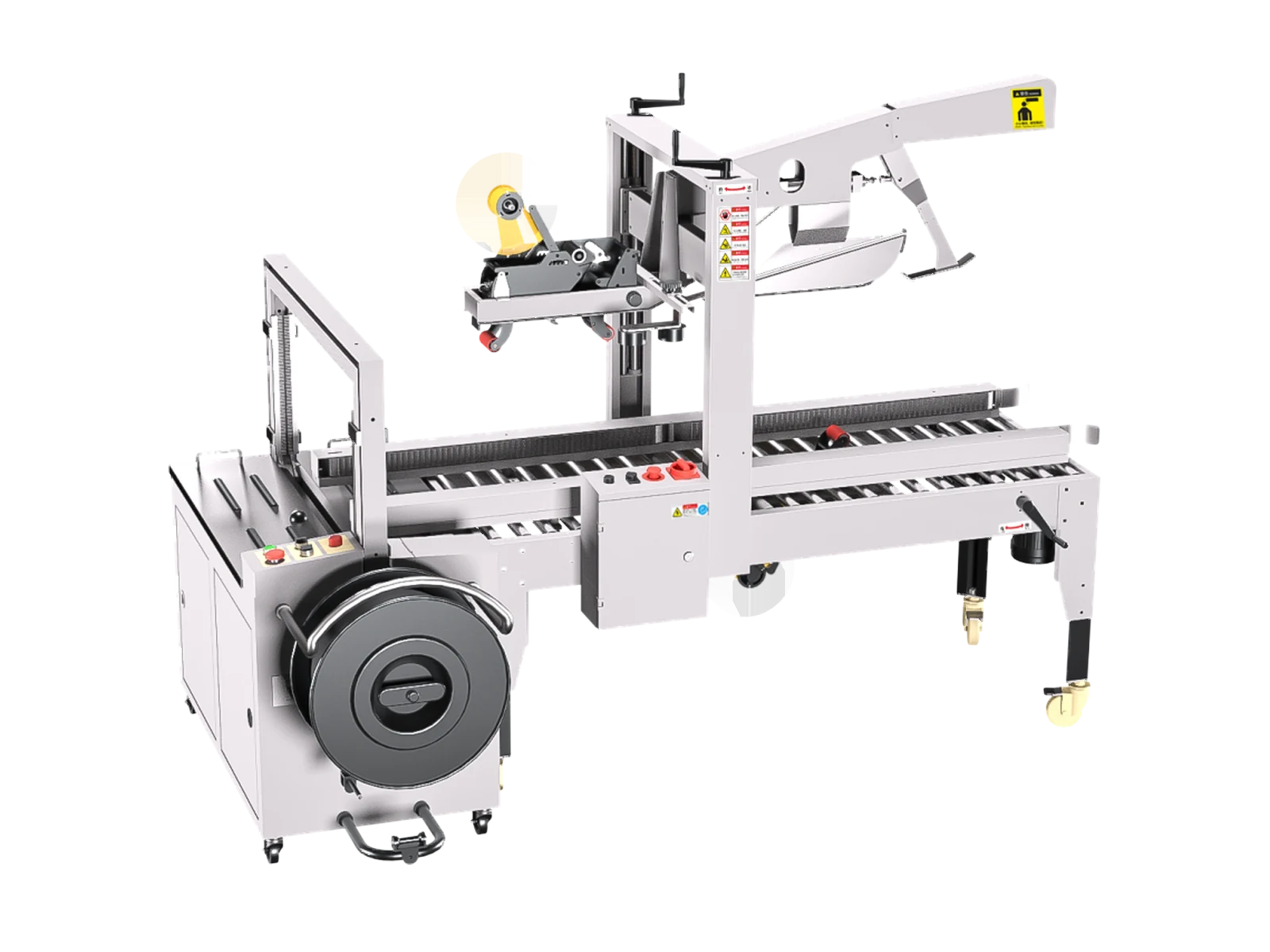
Seal & Strap Unit
Tape and PP strap applied on one base frame
- Carton is folded, taped and strapped without being handled again
- Strapping head runs 2.5 s per strap, PP band 9–15 mm wide
- Brake motor with automatic positioning, so strap placement repeats
- Sealer half is the FZ-655D — same 600 × 500 × 500 mm carton envelope
What each model does to the carton, and what it costs you in floor space
Every sealer here applies standard BOPP tape with the same blade-guarded tape head. What changes is how many runs of tape the carton gets, who folds the top flaps, and how large a carton the frame will accept.
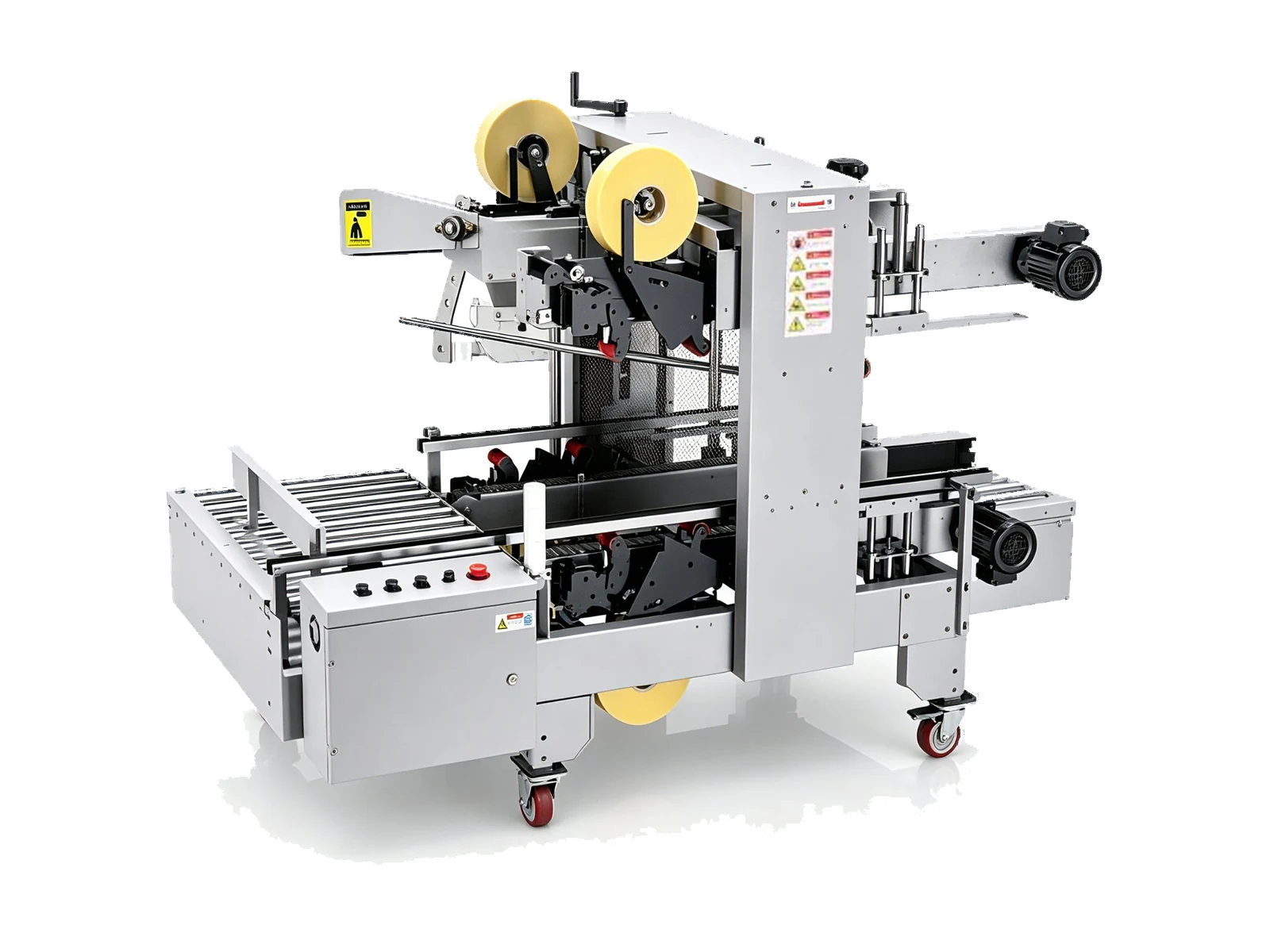
H-Seal Carton Sealer — FJ-755
The FJ-755 tapes the centre seam top and bottom, then turns the carton and tapes both end panels — the H pattern that holds a loaded carton shut even if the board flexes. It is the only model here that seals the end panels, and the only one that accepts a carton 700 mm long at 500 mm high in a single pass.
- Four tape runs in one pass, so no second machine and no carton turning station
- Automatic top flap folding — the operator only loads and unloads
- Blade guard fitted as standard, so the tape cut is shielded from hands
- Tape head is precision-machined and runs smoothly for long production shifts
- Compact footprint relative to its carton size — 1950 × 1250 mm of floor
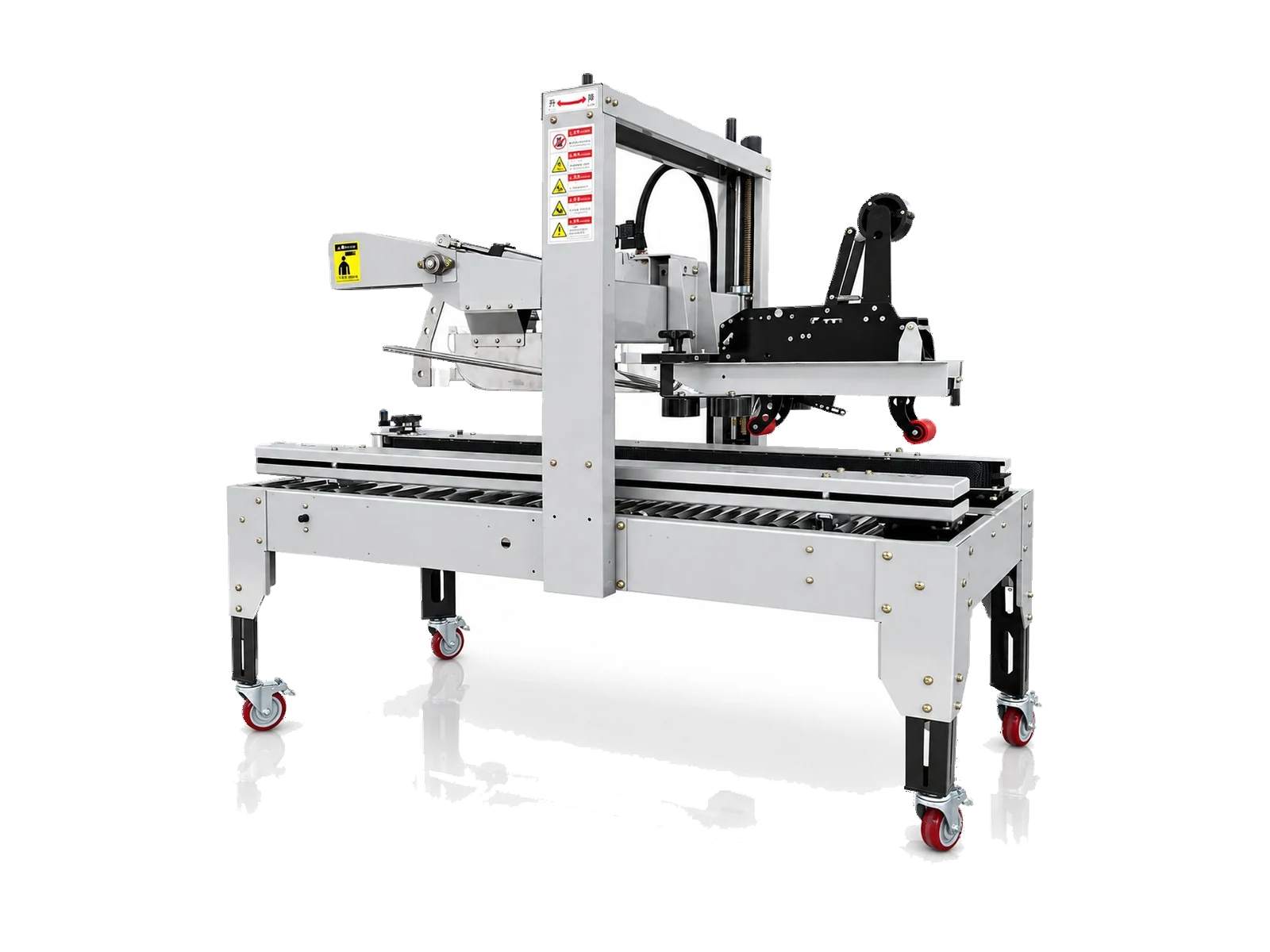
High-Speed Flap Folder — FZ-544
The fastest sealer in the range and the smallest. At 15 to 30 cartons per minute it runs roughly twice the rate of the other flap folders, which is why it is the model specified when the packing bench itself is the bottleneck. The trade-off is the carton envelope: 500 mm maximum length and 400 mm maximum height.
- 15–30 cartons per minute — the highest rate of the six models
- Handles cartons down to 90 mm high — no other model goes lower
- Automatic top folding, bottom-side belt drive from both sides
- 1650 × 1050 × 1350 mm and 175 kg — sits on a bench line without reinforcement
- Suited to e-commerce cartons, cosmetics, electronics and small parts
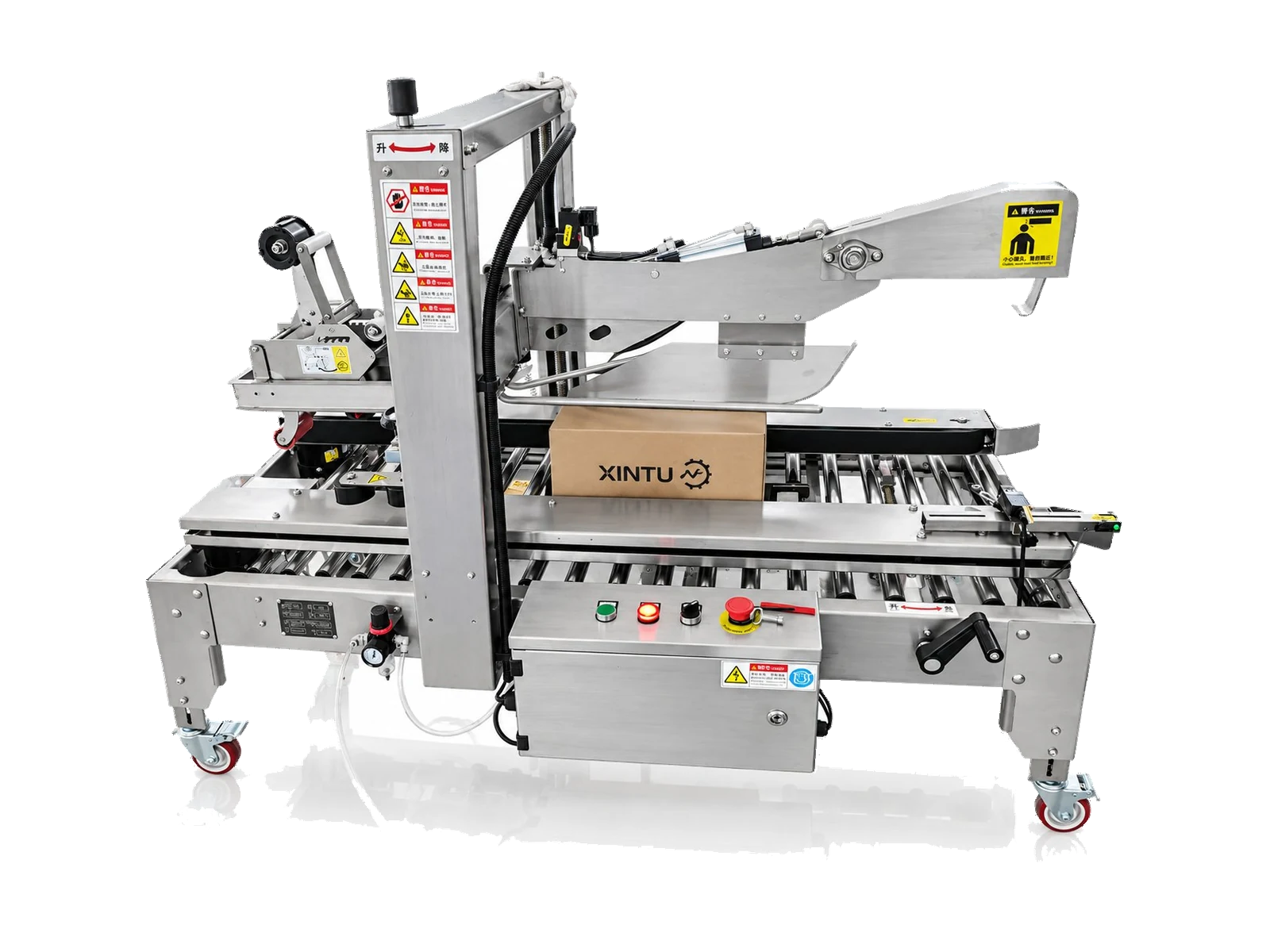
Flap Folding Sealer — FZ-655
The general-purpose model. It takes the same folding and tape heads as the FZ-544 but on a longer, heavier frame, which buys 100 mm on each of the three maximum dimensions — 600 mm length, 500 mm width, 500 mm height. If your carton range is mixed and mostly under 600 mm, this is the one that covers it without swapping frames.
- Carton envelope of 200–600 × 120–500 × 120–500 mm
- Automatic top flap folding; width and height set with hand wheels
- 200 kg frame absorbs the vibration that a compact sealer transmits to the bench
- Blade guard and precision tape head, same as every model on this page
- Available as the FZ-655D when it is paired with a strapping head
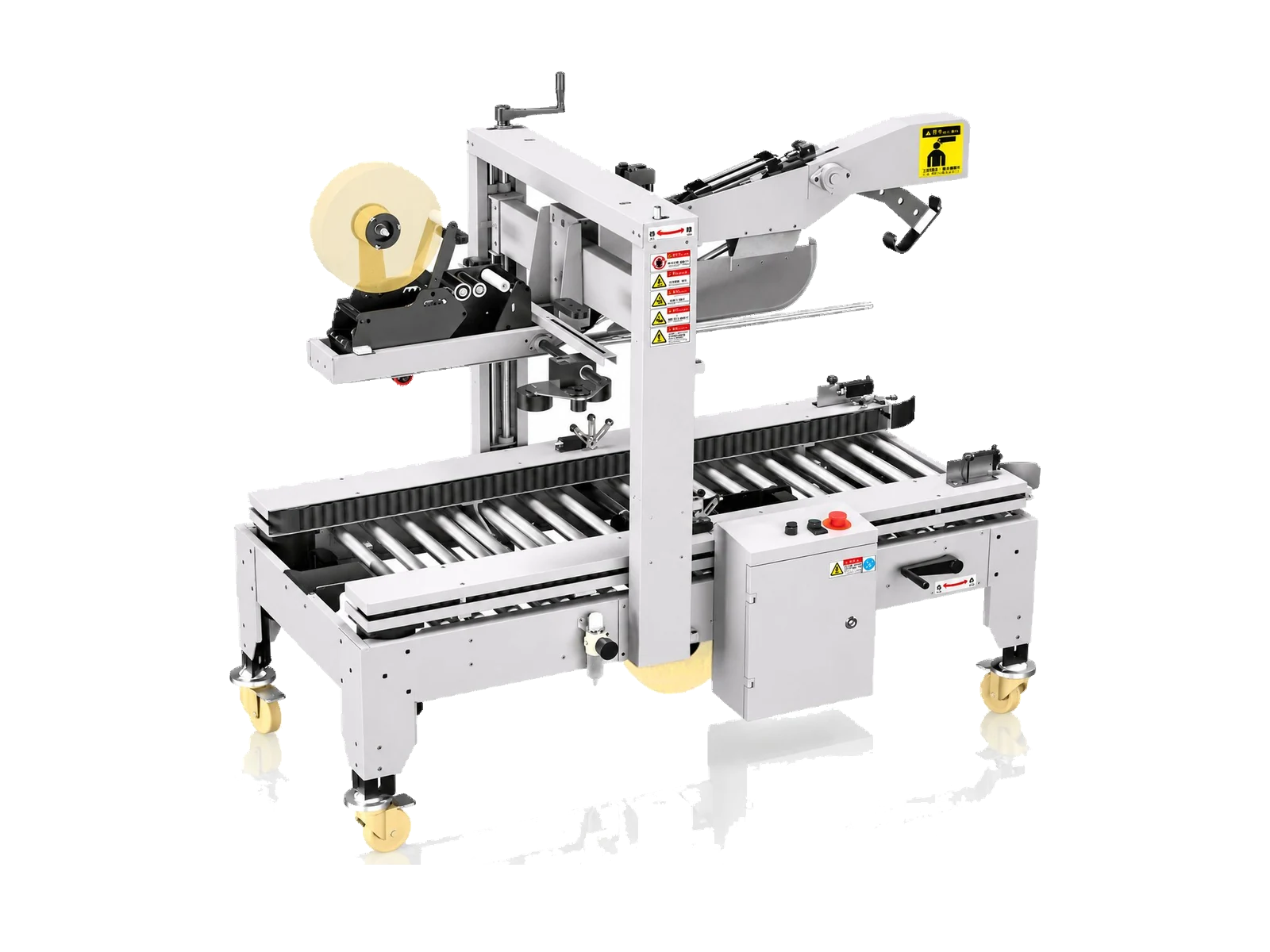
Long-Carton Flap Folder — FZ855
Built for the carton the other models cannot take. At 800 mm of maximum length it covers flat-pack furniture, long hardware, appliance boxes and anything else that runs past the 600 mm ceiling of the FZ-655. It stays the same 10 to 15 cartons per minute because the constraint is the tape run, not the belt.
- 800 mm maximum carton length — 200 mm more than the FZ-655
- Belt speed 20 m/min, identical across the range
- Auto-sleep when idle, which suits a line that runs in batches
- 1980 × 930 × 1700 mm — the tallest and longest frame of the six
- Takes 36–72 mm tape, so it will run the narrower rolls the others will not
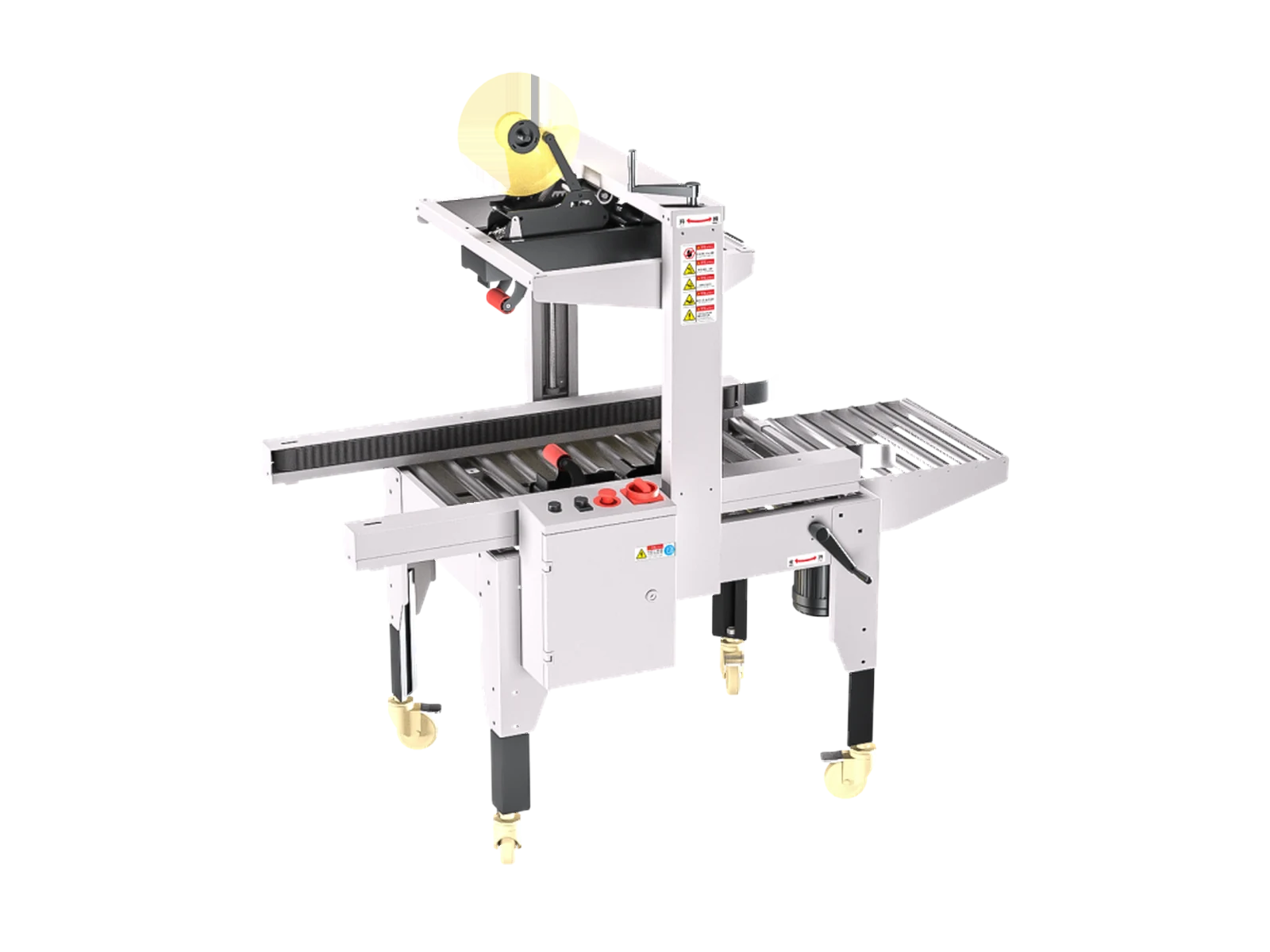
Manual-Fold Sealer — FA500D
The one model with no automatic flap folder, and the only one with no carton length limit at all. The operator closes the top flaps by hand and the machine applies top and bottom tape. That removes the folding head, which is what makes the frame small enough for a single packing bench and long enough for cartons of any length.
- Carton length is unlimited — only width (≤ 500 mm) and height (≤ 500 mm) are capped
- Manual top folding, so irregular or partly crushed cartons can still be sealed
- 1230 × 850 × 1350 mm — the smallest footprint of the six
- Table available at 450, 600 or 750 mm to match your conveyor height
- PLC controlled; runs standalone or inline with upstream and downstream equipment
Seal & Strap Unit — FZ-655D + KZW-8060D
Two machines sold as one set: an FZ-655D flap-folding sealer and a KZW-8060D arch strapper. The carton is folded and taped, then moves straight into the strap arch without being picked up again. Where a shipment spec demands strapping — export cartons, heavy contents, palletised loads — this replaces two separate stations with one run.
- Sealer half is the FZ-655D, so the carton envelope is 200–600 × 120–500 × 120–500 mm
- Strapping head applies a PP strap in 2.5 seconds, band width 9–15 mm
- Brake motor with automatic positioning keeps strap placement repeatable
- Sealer needs 400 W and 6 kgf/cm² air; strapper is electric only at 1000 W / 10 A
- Strapping frame is 1380 × 620 × 1418 mm with a 750 mm table height
The full datasheet, one row per model
Every figure below comes from the manufacturer datasheet for that model. Where a datasheet does not state a value it is left blank rather than estimated — ask us and we will confirm it for your specific carton.
| ModelMachine code | Seal typeTape pattern | OutputCartons / min | Carton Lmm | Carton Wmm | Carton Hmm | PowerTotal | Net weightkg | Machine sizeL × W × H, mm | Tape widthmm |
|---|---|---|---|---|---|---|---|---|---|
| FJ-755H-seal, 4 runs | H-seal | 10–15 | 280–700 | 200–500 | 180–500 | 0.5 kW | — | 1950 × 1250 × 1500 | ≤ 72 |
| FZ-544High-speed folder | One-strip | 15–30 | 200–500 | 120–400 | 90–400 | 0.2 kW | 175 | 1650 × 1050 × 1350 | ≤ 72 |
| FZ-655Flap folder | One-strip | 10–15 | 200–600 | 120–500 | 120–500 | 0.2 kW | 200 | 1750 × 850 × 1600 | ≤ 72 |
| FZ855Long-carton folder | One-strip | 10–15 | 200–800 | 120–500 | 120–500 | 400 W | — | 1980 × 930 × 1700 | 36–72 |
| FZ-655D + KZW-8060DSeal & strap set | One-strip + PP strap | 10–15 | 200–600 | 120–500 | 120–500 | 400 W + 1000 W | 220 (strapper) | 1750 × 850 × 1600 1380 × 620 × 1418 |
36–72 |
| FA500DManual-fold sealer | One-strip | — | 150–∞ | 120–500 | 130–500 | 200 W | — | 1230 × 850 × 1350 | 48–72 |
From carton size to a running sealer
A sealer is a simple machine that fails on one detail: the carton. So we start with the carton and the tape, and pick the model last.
Carton and tape audit
You send three cartons — smallest, largest and typical. We check board grade, flap size and whether the seam sits where the tape head expects it.
Seal type selection
One-strip, H-seal or seal-plus-strap, decided by load weight, stacking height and the shipping spec — not by machine availability.
Model and layout
Model code, frame size against your floor, table height against your conveyor, and the utility requirements on one drawing.
FAT, delivery, commissioning
Run on your own cartons at our factory, then installation, tape threading training and a spare blade set on site.
Six answers, and we can name the model
No specification document needed. These six answers are enough to pick between the six models and quote a frame size that fits your floor.
- Carton sizesSmallest, largest and typical — internal L × W × H in mm
- Carton weight when loadedDecides one-strip versus H-seal, and whether strapping is needed
- Tape you use nowWidth in mm, BOPP or other film — most of the range runs up to 72 mm
- Required outputCartons per minute or per shift — the sustained figure, not the peak
- Line contextManual loading, or fed by a case packer or conveyor at a set height
- Site constraintsFloor space, power supply (220 V or 380 V) and compressed air at 6 kgf/cm²
The single most useful thing you can send is three real cartons — smallest, largest and typical. Carton dimensions on paper and cartons on a conveyor are rarely the same thing: board bulges, flaps spring back, and a half-millimetre of seam offset is enough to send tape off-centre.
If you already know you need strapping, say so — the FZ-655D + KZW-8060D set is quoted and shipped as one unit, on one base frame, so there is one installation and one commissioning visit rather than two.
Where the sealer sits
A sealer is the last thing that touches the carton before it is palletised, and the first thing blamed when a carton arrives open. Its two interfaces — table height upstream, belt speed downstream — are where most integration problems start.
Table height is the number to get right, and it is not the same on every model. The FJ-755, FZ-544 and FZ-655 adjust from 570 to 770 mm on telescopic feet; the FZ855 and the sealer half of the combined set sit at 600 mm (customisable); the FA500D comes at 450, 600 or 750 mm; and the strapper sits at 750 mm. Every model connects to upstream and downstream equipment without modification.
The ones asked before every order
One-strip or H-seal — how do I decide?
Start with what the carton has to survive. A one-strip seal tapes the centre seam top and bottom and relies on the board’s own stiffness to keep the end panels closed. It is fine for cartons that are handled individually and stacked one or two high.
An H-seal adds tape around both end panels. That matters when the carton is heavy, stacked several high, or travels by sea freight where humidity softens the board. The FJ-755 is the only model here that does it, in a single pass, with automatic flap folding.
What is the difference between automatic and manual flap folding?
With automatic folding — the FJ-755, FZ-544, FZ-655, FZ855 and FZ-655D — the machine closes the top flaps as the carton passes, so the operator only loads and unloads. It sets the pace of the line and removes the most common cause of a badly sealed carton: a flap folded short.
The FA500D has no folding head. The operator closes the flaps by hand and the machine applies tape. That is not a downgrade — it is what allows the frame to be 1230 mm long and to accept cartons of unlimited length, which no automatic folder can do.
Can one sealer run several carton sizes?
Yes, within the stated envelope, and the changeover is mechanical rather than electronic. Every model sets width and height with hand wheels — the FJ-755 and the FZ-544 / FZ-655 crank the height and width guides, the FZ855 and FA500D state hand adjustment explicitly. None of them is motorised, which is why there is no servo to fail and no recipe to lose.
Budget a few minutes per size change. If you change size several times a shift, send us the full range at quotation stage — we will tell you whether one frame covers it or whether two models are the cheaper answer.
Which tape width do I need?
Three widths are supported across the range. The FJ-755, FZ-544 and FZ-655 take tape up to 72 mm; the FZ855 and the FZ-655D set take 36–72 mm; the FA500D takes 48–72 mm.
All of them run standard BOPP film, so you are not tied to a proprietary roll. A wider tape is not automatically better — it costs more per carton and, past about 60 mm, adds little holding force on a standard RSC.
When does it make sense to buy the seal-and-strap set?
When the shipping specification requires strapping, not when tape feels insufficient. Export cartons, heavy contents, and loads that are palletised and stretch-wrapped usually carry a strap requirement from the customer or the carrier.
The FZ-655D + KZW-8060D set handles both steps on one base, so the carton is never picked up between sealing and strapping, and both halves are installed and commissioned in one visit. Two separate machines also work — but they need two operators, or a conveyor between them.
Can the sealer be dropped into an existing line?
Yes. Every model on this page is designed to connect to upstream and downstream equipment, and belt speed is a constant 20 m/min across the range — which is what makes mixing models in one line practical.
The two things to check first are table height and air supply. Table height ranges from 450 mm to 770 mm depending on model — see the line section above. Every model except the FA500D needs compressed air at 6 kgf/cm²; volume is 90 nl/min on the FZ-544, FZ-655, FZ855 and the combined set, and 100 nl/min on the FJ-755.
Send the carton. We will name the model.
Three cartons and six answers is enough to come back with a model code, a frame size and a table height that matches your conveyor. No specification document required.