
One wrapper, sized to the pallets you actually ship
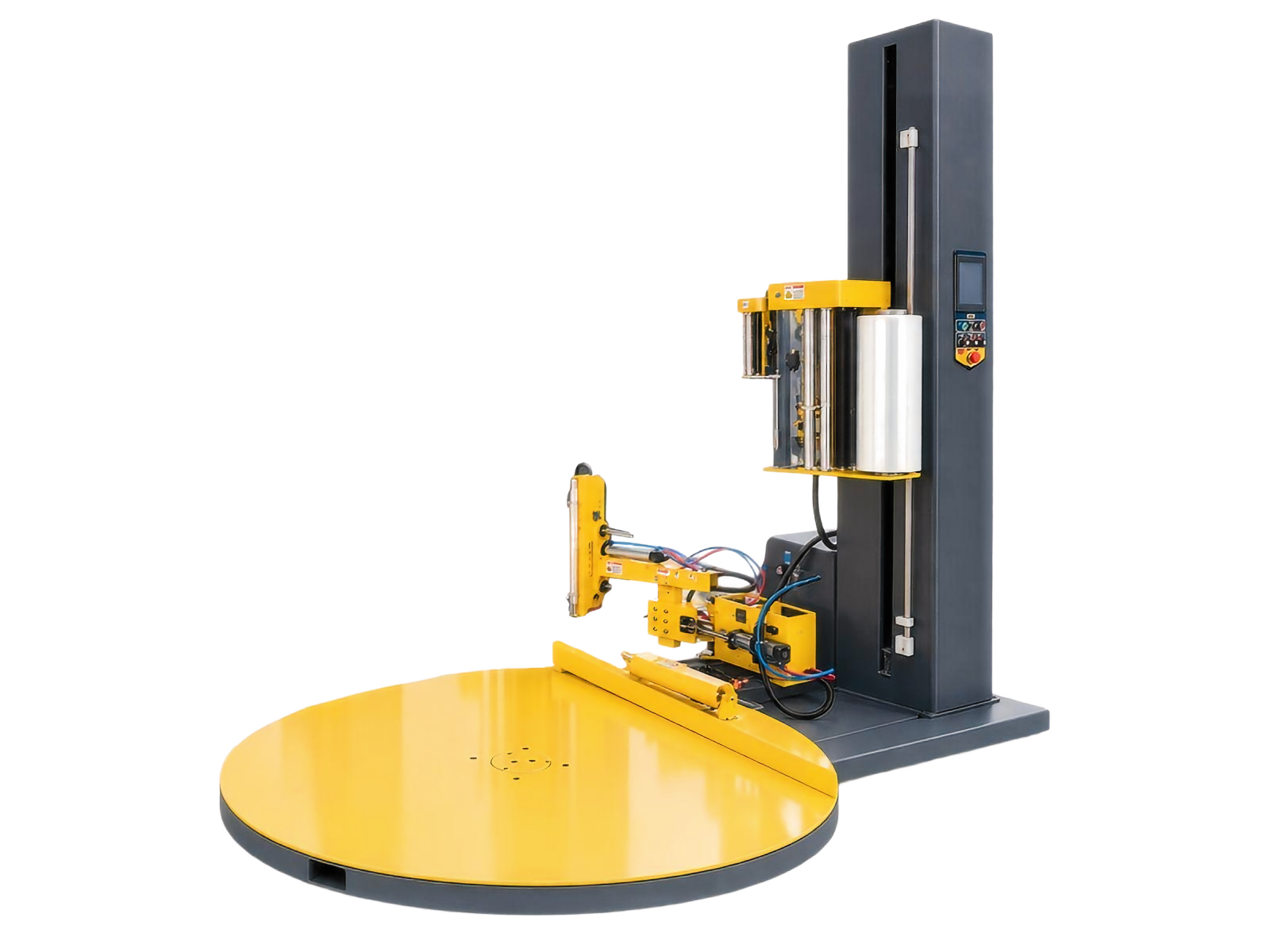
A turntable wrapper is a simple machine, and that is the point: it has one job, and it either takes your pallet or it does not. This one takes anything from 500 × 500 to 1200 × 1200 mm, 600 to 2400 mm tall, up to 1800 kg — and wraps it with up to 250% powered pre-stretch. Built in our own plant, on the same floor as our palletizers.
Turntable diameter,
85 mm off the floor
Tallest load,
pallet included
Heaviest load weight,
on a 2000 kg turntable
Maximum powered
pre-stretch
Your pallet either fits or it does not
There is one model, so there is no range to choose from — the only question worth answering is whether the loads you run today sit inside the box below. Read the maximum column against your tallest, heaviest, widest load, not the average one.
- Dimensions in millimetres unless marked otherwise
- Turntable 1650 mm across — a 1200 × 1200 pallet sits with its corners just past the edge, which is normal for this type
- Heavier than 1800 kg: the turntable takes 2500 kg as an option, and we will say so before you order
Five subsystems, and what each one decides
A wrapper is judged on three things: whether it holds tension, whether it repeats the same wrap at hour eight as at hour one, and whether it can be serviced without a specialist. Those come from five places, and none of them is the frame.
Control system
Independent PLC with recipe memory
- Wrapping layers and cycles configured on the PLC, not fixed in a timer
- Touchscreen showing the PLC operating interface — no laptop on the plant floor
- Photoelectric switch reads the load height, so a short load is not wrapped in thin air
- Film-break and film-out alarms can be enabled or disabled per product
- Fault detection with a monitoring screen, plus a one-touch factory reset
Turntable and chassis
Chain drive on a 10 mm plate
- VFD-controlled 0–12 rpm with a programmed ramp, so the load does not shift on start
- Chain transmission and automatic return to the home position after every cycle
- Forklift slots in the base — the machine moves with a pallet truck, no crane
- 10 mm carbon-steel chassis plate on 8 cast nylon casters
Film frame and pre-stretch
AC motor with its own drive
- Powered pre-stretch rollers rather than a brake bar: the film is stretched by the machine, not by the load
- Separate VFD for lift speed and film feed speed — the two are set independently
- Independent top and bottom wrap counts, because the base and the top edge need different amounts
- Film follow-up mechanism holds tension through the reversal at the top and bottom of the load
Column and lift
Dual chain, modular service
- Dual-chain lift on a 10A chain, so the carriage stays level over the full 2400 mm of travel
- Housing in 1.5 mm wall with 6 mm top and bottom plates
- 6 mm internal corner reinforcement where the mast meets the base — the part that takes the moment
- Modules lift out for service without dismantling the mast
Surface and finish
Outdoor-grade powder coating
- Outdoor-grade powder coat, not a wet paint that chalks over in a humid plant
- Column in Machine Gray RAL9001
- Turntable in Safety Yellow — visible to a forklift driver at floor level
- Base in dark gray, where scuffs and film tails do not show
one metre of roll film covers three and a half metres of load
Pre-stretch is where the film bill is decided, not where the machine cost is
Hand-wrapping stretches film by how hard the operator pulls, which is why two shifts on the same line use different amounts of it. A powered pre-stretch frame does the stretching on rollers before the film reaches the load, at a ratio you set and the machine repeats. At 250%, the film going onto the pallet is already three and a half times its length off the roll — and the elastic memory that holds the load is not spent getting there.
- Roll Φ200–Φ260 mm outside diameter, 500 mm wide, 76.2 mm core — the standard machine-grade roll
- 25–35 µm LLDPE; thinner film at a high ratio covers the same load for less money
- Stretch happens on the rollers, so a soft or unstable load is not squeezed to hold tension
- Follow-up arm keeps tension across the reversal at the top and bottom edge, where hand-wrap always goes slack
What happens between two pallets
The cycle is not fixed: it is the wrap counts and the load height you set. A 600 mm load with two base wraps and two top wraps is a different machine cycle from a 2400 mm load with six of each — which is why we quote cycle time against your load rather than a headline number.
Load on and measure
The pallet goes on with a pallet truck. The photoelectric switch reads the height of the load and the recipe picks the wrap count that matches it.
Base wraps
The turntable returns to its home position and starts. The film carriage sits at the bottom edge and applies the base count — the turns that stop the load sliding off the pallet.
Spiral to the top
The carriage travels up as the turntable turns. Pre-stretch holds tension constant, and the top count adds the extra turns under the top edge that keep the stack from opening in transit.
Return and release
The carriage comes back down, the turntable stops at home, and the finished load comes off on the same side it went on. Nothing about the next load depends on the operator remembering a setting.
Every figure, on one page
One model, so the table runs down rather than across. Every number below is from the machine’s own datasheet — if a figure you need is missing, it means we do not publish it, and we will answer it directly.
| ParameterXINTU XT-SW1650 | ValueTurntable stretch wrapper |
|---|---|
| Work envelope | |
| Load footprint, L × W | 500 × 500 – 1200 × 1200 mm |
| Load height, pallet included | 600 – 2400 mm |
| Maximum load weight | 1800 kg |
| Turntable load capacity | 2000 kg (2500 kg optional) |
| Turntable diameter | 1650 mm |
| Turntable height | 85 mm |
| Machine dimensions, L × W × H | 2550 × 1650 × 2850 mm |
| Machine weight | 550 kg |
| Turntable and drive | |
| Turntable speed | 0 – 12 rpm, VFD |
| Turntable motor | 0.75 kW |
| Transmission | Chain |
| Chassis plate | 10 mm carbon steel |
| Casters | 8, cast nylon |
| Chassis chain | 12A |
| Turntable reset | Automatic, each cycle |
| Film and pre-stretch | |
| Film type | LLDPE, machine grade |
| Film thickness | 25 – 35 μm |
| Film roll, outside diameter | Φ200 – Φ260 mm |
| Film roll width | 500 mm |
| Film core | Φ76.2 mm ID × 520 mm |
| Maximum pre-stretch | 250 % |
| Film frame lift motor | 0.37 kW |
| Film frame chain | 10A, dual |
| Top and bottom wrap counts | Set independently |
| Column and lift | |
| Lift | Dual chain, 10A |
| Housing wall | 1.5 mm |
| Top and bottom plates | 6 mm |
| Internal corner reinforcement | 6 mm |
| Control | |
| Controller | Independent PLC, configurable layers and cycles |
| Interface | Touchscreen, PLC operating screen |
| Load height detection | Photoelectric switch |
| Layer counts | Top, bottom and reciprocating set individually |
| Alarms | Film break and film out, enable or disable |
| Diagnostics | Fault detection with monitoring screen |
| Reset | One-touch factory reset |
| Power and installation | |
| Power consumption | ≈1.5 kW |
| Supply | 220 V / 50 Hz, single phase |
| Ambient temperature | −10 to 40 °C |
| Grounding resistance | < 10 Ω |
| Location | Indoors, level sealed floor |
What the machine needs from your floor
A wrapper installs in a day and does not need a pit, a foundation or a three-phase supply. These are the four things worth checking before it arrives.
- Supply
- 220 V / 50 Hz, single phase
- Consumption
- ≈1.5 kW
- Grounding
- < 10 Ω
- Machine footprint
- 2550 × 1650 mm
- Overall height
- 2850 mm
- Working room
- Pallet-truck access on the load side
- Location
- Indoors, level sealed floor
- Ambient
- −10 to 40 °C
- Machine weight
- 550 kg, on 8 casters
Six answers, and we can confirm it fits
There is no configuration to work through on a single-model machine. These six answers are enough to confirm the load fits, name the film, and give you a cycle time you can check against your own shift.
- Pallet sizeLength and width, including any overhang the product has past the pallet
- Load heightThe tallest finished load, measured from the floor
- Load weightTypical and heaviest — not the average of the shift
- ThroughputLoads per hour, or loads per shift, and whether the wrapper is the bottleneck
- FilmThickness and roll size you buy now — or let us quote film with the machine
- What comes nextPallet conveyor, labeller, or straight onto a truck
The figure people get wrong is load height. It is measured from the floor to the top of the finished stack — not the height of the pallet, and not the height of the product before it was stacked. A load that comes in at 2450 mm is outside the machine, and finding that out at the quotation stage is cheaper than finding it out at the trial.
The second is weight. The turntable is rated 2000 kg, and the load limit is 1800 kg — the gap is not a selling trick, it is the reserve that lets the machine stop and start a heavy load without the chain taking a shock. If your loads run at 1900 kg, say so and we will quote the heavier turntable rather than let you find the limit.
The last machine before the truck
The wrapper is where the load stops being a stack of boxes and becomes something a carrier will accept. It is also the cheapest machine in the line, which is why it is usually the last one automated — and the one where a retrofit pays back fastest.
The six things buyers ask before ordering
Fit, power, throughput, short loads, film breaks and who actually builds it. If your question is not here, send it — the answer is usually short, and it is better to have it before the order than after.
Will my 1200 × 1000 pallet fit?
Yes — 1200 × 1000 and 1200 × 800 both sit well inside the 500 × 500 to 1200 × 1200 footprint range. A 1200 × 1200 pallet has a diagonal of about 1697 mm against a 1650 mm turntable, so its corners sit a couple of centimetres past the edge. That is normal for a turntable wrapper and the base is built for it, but if the pallet is 1200 × 1200 and the load is heavy, tell us and we will check it against the turntable rating rather than assume.
Does it need three-phase power?
No. The machine runs on single-phase 220 V / 50 Hz and draws about 1.5 kW — less than most of the conveyors feeding it. Grounding resistance should be below 10 Ω, which is a normal plant earth. Because there is no three-phase requirement, the wrapper can go into a corner of a warehouse without an electrical upgrade.
How many pallets an hour will it do?
That depends on your wrap counts and your load height, so we quote it against your load instead of publishing a headline number. A short load with two base wraps and two top wraps turns far faster than a 2400 mm load with six of each — and the pallet-change time in between is set by how fast the operator swaps loads, not by the machine. Give us the wrap counts and we will give you the cycle time.
Can it wrap a load that is shorter than the machine?
Yes. A photoelectric switch reads the height of each load, so the carriage stops at the top of the load rather than travelling to the machine’s maximum and wrapping air. That is the difference between a wrapper that wastes film on every short load and one that does not — on a mixed pallet height line it is the single biggest film saving.
What happens if the film breaks or runs out?
The machine detects both and stops. Film-break and film-out alarms can each be enabled or disabled per product, because on some loads a break is worth stopping for and on others it is not. Fault detection reports through the monitoring screen, and a one-touch reset returns the machine to its start position once the film is re-threaded.
Are you the factory, or a reseller?
We are the factory. The XT-SW wrapper is designed and built in our own plant — the same floor that builds our case erectors, case packers, sealers and palletizers. That is why the film frame, the column and the control cabinet are ours rather than assembled from bought-in modules, and why a question about a wrap count comes back as an answer instead of a forwarded email.
Send the pallet size. We will confirm it fits.
One model, one answer: whether your load sits inside the envelope, which film to run, and how long a cycle takes on your wrap counts.