
Most case packer projects fail for a boring reason: the machine format was chosen before the product was understood. A drop packer that works beautifully on 500 ml PET bottles will destroy a 40 g pillow bag. A top-load cell that handles cosmetics jars at 20 cycles a minute will lose money on a co-packer running nine SKUs a week. The machine is not the variable — the match is.
This guide compares the five case packer families we build and integrate, using the same criteria for each: how the product enters the case, the speed band, the product and case formats that actually fit, and the costs that do not appear on the quotation.
Key takeaways
- Five families cover almost every application: drop, top-load, side-load, wrap-around and robotic. Each is the right answer for a different product geometry, not a different price bracket.
- Speed is a symptom, not a spec. A machine rated at 25 cases per minute rarely delivers 25 at your changeover frequency, product mix and case quality.
- The cheapest quotation is usually the one with the most expensive consumables — board, tape, spare tooling, and changeover labour.
- Run the ten-question checklist at the end of this article before you ask for a quotation. Suppliers quote what you specify.
The five case packer families at a glance
Every case packer answers one question: in which direction does the product enter the case, and who holds it while the case closes?
| Family | How product enters | Speed (cpm) | Best for | Case style | Capex |
|---|---|---|---|---|---|
| Drop (vertical) | Collated above the case and released through a lane or funnel | 15–20 cpm; up to 40 cpm with a dual-lane setup | Rigid containers: cans, jars, tubs, thick-wall bottles | RSC, regular slotted | Lowest |
| Top-load (servo) | Picked from above by servo gantry and lowered in | 15–20 cpm | Upright, self-supporting items: jars, boxes, cartons, pharma | RSC, display-ready cases | Medium |
| Side-load | Pushed horizontally into a case lying on its side, then turned upright | 15–20 cpm | Flexible bags, pouches, boxed food, tight retail packs | RSC, SRP trays | Medium |
| Wrap-around | Flat blank wrapped around the collation, glued | 15–25 cpm | Cans, bottles, jars — dense, uniform loads | One-piece wrap-around blank | Medium–high |
| Robotic | Robot picks with a tool matched to the product and places it | Up to 30 cpm (cycle-time and tooling dependent) | Mixed formats, fragile items, multi-SKU lines | Any case the tool can enter | Highest |
Speeds are indicative for standard configurations and depend on case size, pack pattern, product stability and board quality. Always validate against your own product.
1. Drop-type case packers: speed for rigid containers
A drop packer collates the product above an open case and releases it. The case then indexes forward for sealing. There is no gripper, no robot and very little to go wrong — which is why drop packers are the most cost-effective way to pack high volumes of rigid containers.
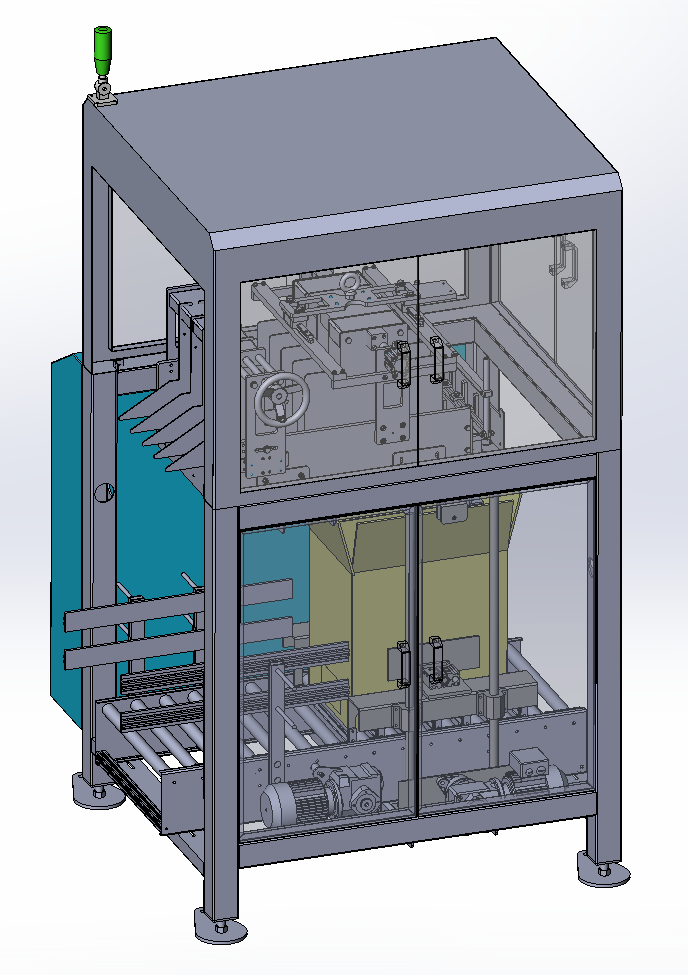
Where it wins: beverage, edible oil, sauces, canned goods, household chemicals — anything with a rigid wall and a flat base. Changeover is mechanical and fast, tooling is inexpensive, and maintenance is within reach of an in-house technician.
Where it fails: anything that deforms, slides or cannot tolerate a fall of 100–200 mm. Pillow bags, thin-wall cups, glass with a narrow neck, and products with loose closures are all poor candidates. Noise is also higher than pick-and-place formats, which matters if the line sits near a packing hall.
Specify carefully: the drop height, the lane geometry and the case-flap support. Most damage in drop packers happens in the last 30 mm — not because the drop is too high, but because the flaps are not fully controlled as the product lands.
2. Top-load case packers: control over speed
Servo-driven top-load packers pick the product from above, move it over the case and lower it into position. Because the product is held for the whole transfer, orientation is controlled to the millimetre — which is what makes this format the default for cosmetics, pharmaceuticals, nutritional supplements and premium food.
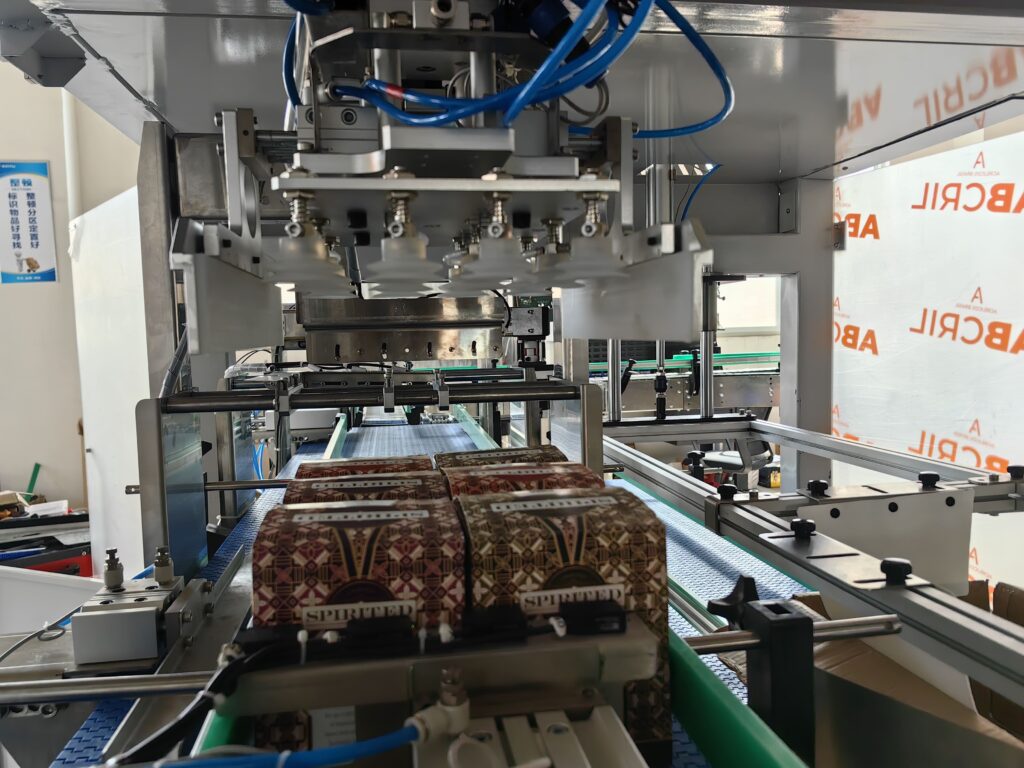
Typical range: 15–20 cases per minute, with cycle time set by the longest axis of travel and the number of products per cycle. Twin-gantry and multi-head designs push throughput up without increasing machine speed.
Real constraints: one gripper set per product family. If your SKU list includes a 30 mm jar and a 120 mm carton, budget for quick-change tooling and the minutes it takes to swap it — or pay for a servo-adjustable head that handles both.
3. Side-load case packers: the answer for flexible packaging
Side-load machines present the case horizontally, push the collated product in from the side, then turn the case upright and send it to sealing. It sounds like a detail. In practice, it is the only reliable way to pack a bag that cannot stand on its own.
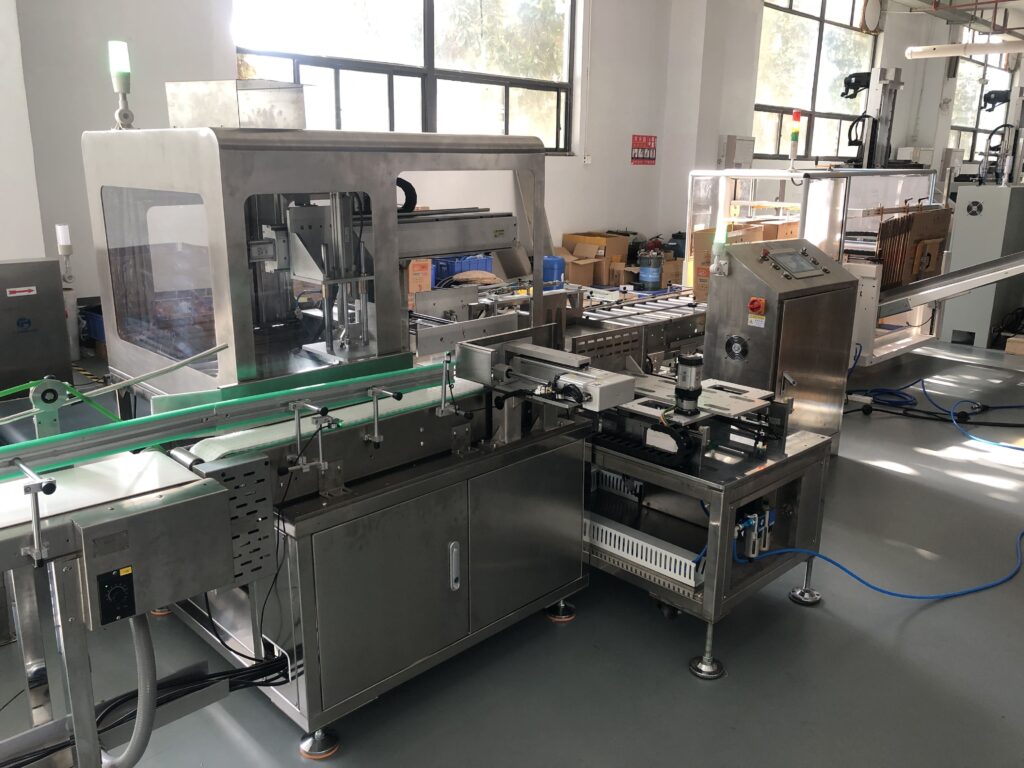
Why it suits flexible packaging: the bag is never dropped and never gripped from the top. It is pushed as a controlled block, with the case wall acting as the guide. Bag folding at the case edge — the most common defect in snack packing — drops sharply when the transfer is horizontal and the case is already in position.
Typical range: 15–20 cases per minute. For boxed food, a well-tuned side-load machine can place twelve cartons in about five seconds; the limit is usually the collation and case-erecting side, not the loader.
What to insist on: a flighted infeed with product pitch control, a top hold-down belt over the loading zone, and a case-present sensor that stops the pusher mid-stroke rather than crushing a mis-formed case.
4. Wrap-around case packers: less board, more stability
A wrap-around packer does not put product into a case. It wraps a flat blank around the product and glues the result into a case. The load and the case become a single rigid block, which is why beverage producers with glass and cans favour the format.
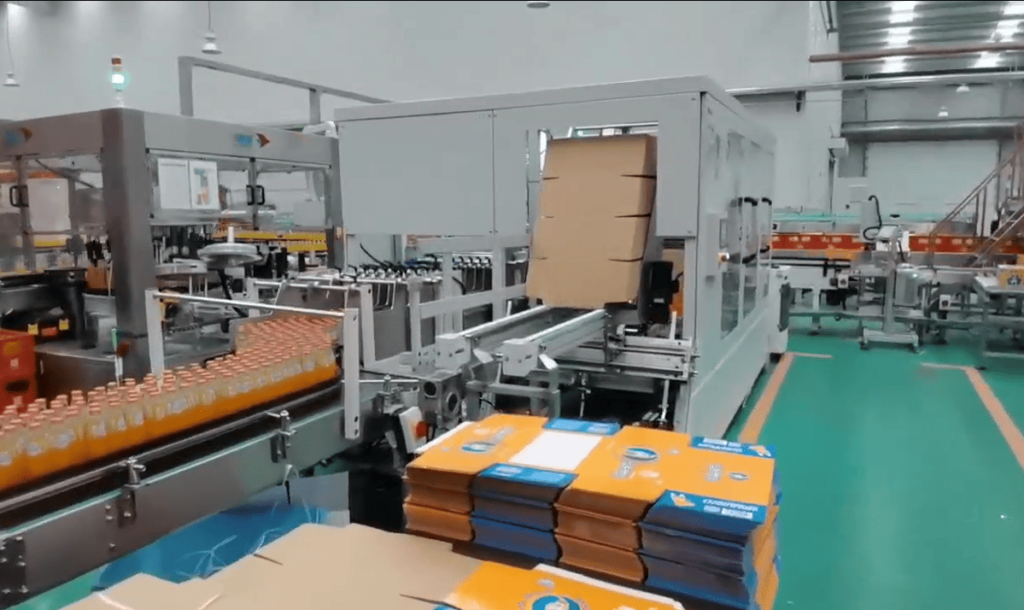
Typical range: 15–25 cases per minute. The format is at its best on a single, stable pattern running for long campaigns — glass bottles, cans, tetra packs, jars.
The trade-off: one blank per pattern. Change the pack count and you change the blank, which means a minimum order quantity, storage, and a supplier lead time. If your marketing team likes to test pack sizes, this is the format that punishes it.
The hidden win: board reduction of 20–40% against an RSC is not a rounding error at 20 cases a minute, three shifts a day. It is usually the single largest line item in the total cost of ownership — larger than the electricity, larger than most maintenance budgets.
5. Robotic case packers: one machine, many SKUs
A robot does not care what the product is, as long as the tool fits. That is the entire commercial argument for robotic case packing: the machine is expensive per case, but it is the only format that absorbs a changing product mix without new mechanics.
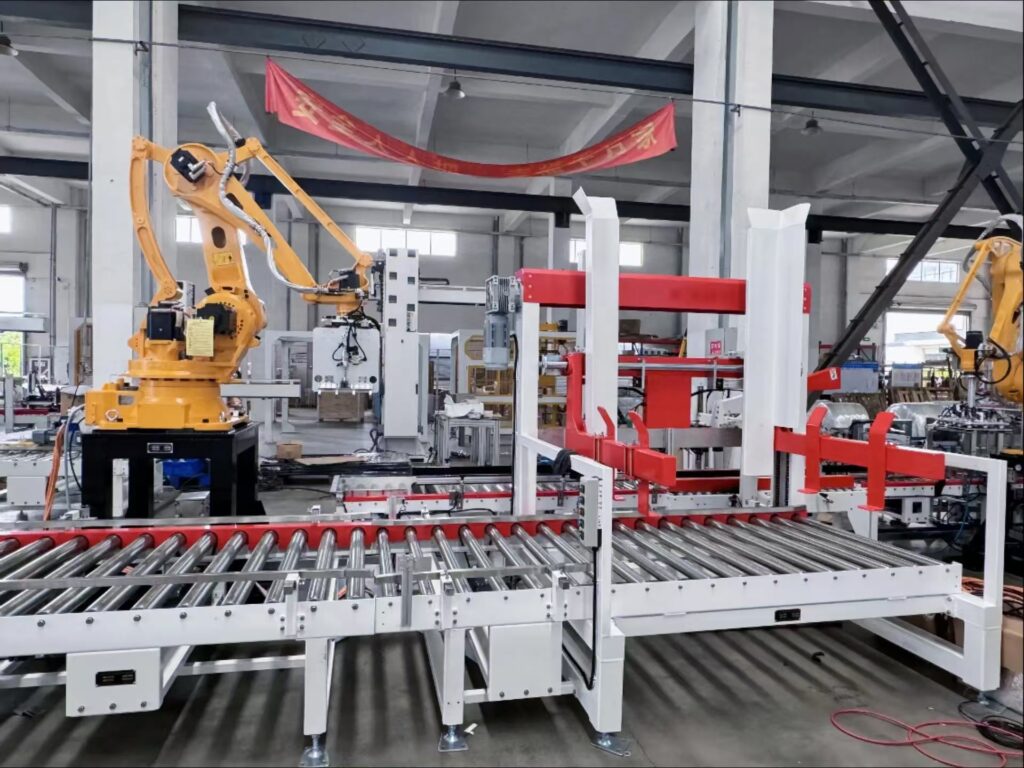
Typical range: up to 30 cases per minute on favourable patterns, with vision-guided picking and recipe-based pattern changes in minutes rather than hours.
When it is the wrong answer: a single SKU at high volume, running 24/7. You will pay for flexibility you never use, and a drop or wrap-around machine will out-run it at half the capital cost.
How to choose, in the right order
Work through these six questions before you look at any quotation. The order matters — each answer narrows the field for the next.
- Can the product survive a drop? If yes, drop packing is on the table. If no, it is not, regardless of price.
- Can the product stand and be gripped from above? If yes, top-load and robotic are viable. If no — bags, pouches, limp packs — side-load is the natural home.
- What case do you already ship in? A wrap-around blank is not an RSC. If your customers, retailers or export pallets dictate the case, that constraint decides the machine, not the other way round.
- What is the real line speed, including stops? Size the packer for the sustained rate, not the peak. A machine running at 90% of its rated speed every day is a machine you will replace in three years.
- How many SKUs, and how often do they change? More than five changeovers a week pushes you toward robotic or servo-adjustable tooling. One campaign a month pushes you toward the simplest mechanics you can buy.
- Where does the machine physically go? Infeed height, available length, operator access, and the distance to your existing case sealer decide more layouts than most buyers expect. A side-load machine is shorter than a top-load cell; a wrap-around machine is shorter still.
Costs that are not on the quotation
- Board. Wrap-around typically saves 20–40% of board against an RSC. Over a year at three shifts, this often exceeds the price difference between the two machines.
- Changeover time. Two hours of changeover per shift, at 20 cases a minute, is 2,400 cases of lost output per day. Ask for a measured changeover, not a promised one.
- Tooling. Every new pack size is a new set of guides, grippers or funnels. Request a tooling price list with the quotation, not after the purchase order.
- Compressed air and power. Vacuum-based top-load machines draw more air than mechanical grippers; the compressor is part of the project cost.
- Line balance. A 25 cpm packer feeding a 15 cpm sealer produces 15 cpm and a lot of stoppages. Accumulation tables are not optional extras.
The ten-question RFQ checklist
Send these with your enquiry and the quotations you receive will be comparable — and buildable.
- Product samples: at least 20 units per SKU, in the retail packaging that will run on the line.
- Product dimension and weight range, including the largest and smallest variant.
- Target sustained speed (cases per minute) and the shift pattern.
- Case specification: internal dimensions, board grade, style, and tolerances.
- Closing method: hot melt, tape, or pre-glued.
- Pack pattern drawings, including layer count and orientation.
- Line layout with infeed height and available floor space.
- Utilities available at the installation point: power, air pressure and flow.
- Environment: washdown, temperature, dust, and any food-safety certification required.
- Acceptance criteria: jam rate, count accuracy, changeover time, and the FAT protocol you will both sign.
Frequently asked questions
Which case packer is best for flexible bags?
Side-load, in most cases. The case lies flat during loading, so the bag is supported on all sides and is never dropped or gripped from above. Top-load machines with vacuum or clamp tooling can also work for stiffer pouches, and robotic cells are viable when the SKU mix is wide.
Can one machine handle both bags and bottles?
Only with a robotic cell and two tool sets, and even then the case handling differs. In practice it is cheaper to run two dedicated machines than one compromise — the exception is a co-packer running low volumes of many formats.
How accurate are the speed figures suppliers quote?
They are usually achievable on a single, well-behaved SKU with a perfect case supply. Ask for the speed at your changeover frequency and with your board grade. A machine rated at 25 cpm that delivers 18 in your plant is not a lie — it is a different test condition.
Do I need a case erector as well?
If you buy cases flat, yes — either a separate erector or an integrated erecting section. Integrated erecting saves floor space and labour but ties the packer to one case size at a time. We build both configurations, and the choice usually comes down to how many case sizes you run.
What is a realistic lead time?
Standard configurations typically run 8–14 weeks from drawing approval, plus shipping and commissioning. Custom tooling, integrated erecting and line-level controls add to that. Anything quoted at four weeks is either in stock or not customised to your product.
Next step
Send us the product and the case, and we will tell you which of the five formats fits — including the ones we would not recommend selling you. A one-page line study with a dimensioned layout is usually enough to settle the question before anyone talks about price.
Request a line study for your product → | See our case packing range | Read how other producers solved this