
Manual palletizing has a ceiling, and it is lower than most plants think. A fit operator lifting 15 kg cartons will average 6–8 cartons a minute across a shift — and that average includes the last hour, when the pace drops and the pallet quality with it. Everything upstream can be automated, but if the end of the line is still two people stacking boxes, that is where your capacity is set.
This article compares the three ways to automate that last five metres — a layer palletizer, an articulated robot cell, and a collaborative robot cell — on the criteria that actually decide the project: throughput, footprint, guarding, changeover, and payback.
Key takeaways
- Throughput bands are well separated: layer palletizers 25–40 cartons/min, industrial robots 12–20, cobots 8–12. Your line speed picks the category before price does.
- Footprint and guarding, not speed, are what usually rule out an industrial robot cell in an existing plant.
- A cobot is not “a slow robot”. It is a different safety model — and that model is what makes retrofit projects possible without rebuilding the line.
- Payback comes from labour, injury cost and pallet quality, in that order. Model all three, or the numbers will not hold up in a capital committee.
What manual palletizing really costs
The visible cost is wages. The expensive parts are the ones that do not appear in the labour budget:
- Throughput capped by fatigue. Output tracks human endurance, not machine capacity, so upstream equipment runs below its rated speed for the whole shift.
- Injury and absence. Repetitive lifting of 10–40 kg cartons at 6–8 per minute is a recognised musculoskeletal risk. Claims, retraining and replacement staff are a recurring cost, not a one-off.
- Inconsistent pallet quality. Hand-stacked pallets are rarely square. The cost appears downstream — in stretch-wrap consumption, in transit damage, and in the customer complaint you cannot trace.
- Recruitment. Finding people willing to stack boxes for eight hours is getting harder in most industrial regions, and the ones who stay are the ones you least want to lose.
The three configurations, compared
| Layer palletizer | Industrial robot cell | Cobot cell | |
|---|---|---|---|
| Throughput | 25–40 cartons/min | 12–20 cartons/min | 8–12 cartons/min |
| Payload | Pattern-limited (whole layer) | Up to 100+ kg | 10–40 kg per pick (typical) |
| How it works | Builds a full layer, then places it with a row pusher or fork | 6-axis arm, one or more cases per cycle, custom EOAT | Force-sensing arm, one case per cycle, light EOAT |
| Footprint | Large — pattern-forming area plus pallet stations | Medium, plus a safety fence | Smallest; often retrofits into an existing corner |
| Guarding | Full perimeter fence | Full perimeter fence with interlocks | Risk-assessed cell, frequently no fence; safe-stop behaviour |
| Best fit | One or two SKUs, high volume, 24/7, few pattern changes | Heavy cases, high speed, stable product mix | Mid-volume, mixed SKUs, space-constrained retrofit |
| Max pallet height | Typically 2.0–2.4 m | Application-dependent, often 2.5 m+ | 2.3 m in our standard builds |
| Changeover | Mechanical pattern change, longest | Recipe-driven, fast | Recipe-driven, minutes on the teach pendant |
| Relative capex | High | High | Medium |
Figures reflect typical XINTU configurations and mainstream industry ranges. Actual output depends on case size, pattern, conveyor layout and pallet height.
When a cobot cell is the right answer
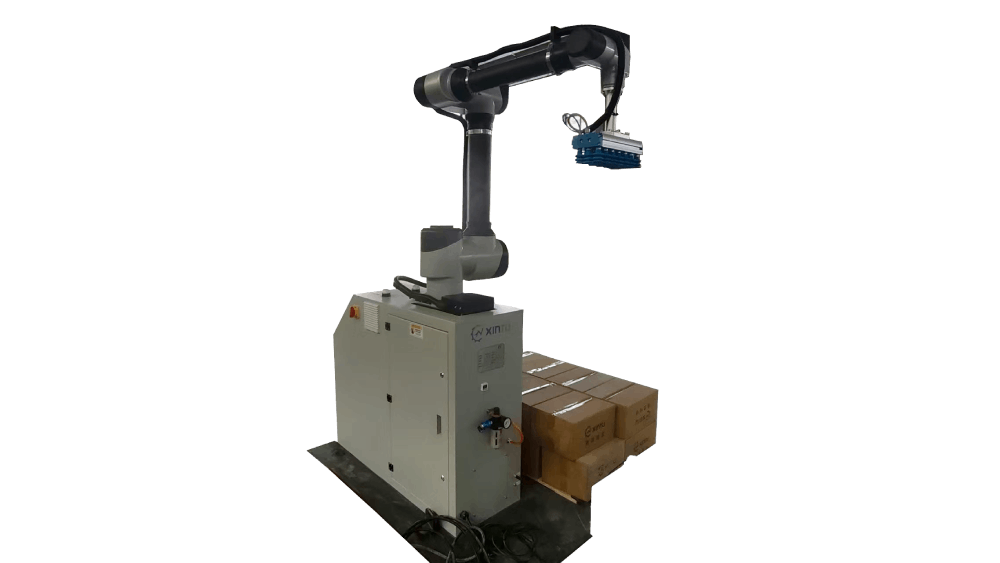
Collaborative robots were not designed to be fast. They were designed to be safe around people and easy to redeploy, and those two properties solve a specific set of problems very well:
- The line is already built. A cobot cell can be dropped into an existing corner without a fenced enclosure, which is often the difference between a project that gets approved and one that does not.
- Volumes are mid-range. 8–12 cartons per minute matches a large share of food, beverage and consumer goods lines that were never going to justify a 40 cpm layer machine.
- The SKU list moves. New pallet patterns are created on the teach pendant in minutes, by the customer’s own team, without calling an engineer.
- Timeline matters. Delivery and commissioning typically run 6–12 weeks depending on site readiness — short enough to fit inside a financial year.
When you need a layer palletizer instead
If the answer to all of the following is yes, a layer palletizer will out-perform any robot on cost per carton:
- One or two case sizes, stable for the foreseeable future.
- More than 25 cartons per minute, sustained.
- Three shifts, five or more days a week.
- Pattern changes less than once per shift.
- Floor space available for a pattern-forming station and two pallet positions.
The industrial robot sits between the two. It is the right choice when cases are heavy (above 40 kg), when the product cannot be layer-formed because it is unstable, or when a single cell must serve two production lines.
Safety: the part that decides the layout
Automation projects are frequently delayed at the risk assessment stage, because the safety concept was chosen after the layout was drawn.
- Industrial cells follow ISO 10218-1/-2. Assume a fence, interlocked gates, and a safety-rated stop circuit. That fence costs floor space and, in a tight plant, it is often the real blocker.
- Cobot cells follow the same base standard plus ISO/TS 15066 for collaborative operation. A cobot is not automatically fence-free — the risk assessment decides. Force and pressure limits, approach speed, and the tooling design all matter. A vacuum gripper holding a 20 kg case at 1.5 m/s is not a low-risk application, whatever the arm is rated for.
- Either way, the risk assessment must cover the whole cell: pallet dispenser, conveyors, stretch wrapper, and the operator’s path to the manual override.
The practical advice: ask for the risk assessment concept in the technical offer, not after the purchase order. A supplier who cannot describe the safety concept before the site survey has not thought about your plant.
Modelling the payback
Three benefit streams, and one of them is usually left out of the business case.
| Benefit | How to estimate it | Typical order of magnitude |
|---|---|---|
| Direct labour | FTEs removed × fully loaded annual cost | Largest single line; 2–4 FTE is common for a two-shift operation |
| Injury and absence | Claims history + overtime cover + retraining | Often 10–25% of the labour figure |
| Pallet quality and OEE | Fewer downstream stoppages, less stretch film, lower transit damage | 5–15% of the total benefit, but the easiest to defend with data |
Worked example. A two-shift food plant removes four palletizing FTEs at a loaded cost of €18,000 each: €72,000 a year. Add €8,000–12,000 for injury cover and overtime, and €6,000 for film and damage reduction. That is roughly €86,000–90,000 of annual benefit. Against a cobot cell at €110,000–140,000 installed, payback lands between 15 and 19 months — before any throughput gain is counted. If the cell also lifts output from 6–8 to 10–12 cartons a minute and the plant can sell that capacity, the case becomes straightforward.
What breaks these models is not the arithmetic, it is the assumptions: FTEs that are not actually removed (they are redeployed, which is fine, but then they are not a saving), or a throughput gain the sales team cannot fill. Be conservative and the project survives scrutiny.
A real deployment, in numbers
A mid-sized food manufacturer running continuous day and night shifts had four palletizers handling cartons up to 40 kg by hand. Throughput was capped at roughly 6–8 cartons a minute by fatigue, pallet patterns were inconsistent, and injury risk was the plant’s largest single exposure.
The installed cobot cell — high-payload arm with force sensing, a custom hybrid vacuum/mechanical gripper, pallet dispenser, outfeed conveyor, and pattern software — reached 8–12 cartons a minute, stacks to 2.3 m, and removed all four direct palletizing roles, with staff redeployed to quality and line supervision. No recordable safety incidents were recorded during the observation period, and pallet quality became repeatable enough to reduce downstream stoppages.
The detail that made it work was not the robot. It was the gripper: cartons from 10 to 40 kg with different surface finishes need a tool that can hold without crushing, and that tool was designed around the customer’s case range rather than bought from a catalogue.
Specification checklist
- Case dimensions and weight range — minimum, maximum, and the distribution between them.
- Sustained cartons per minute required, and the peak.
- Pallet size, pattern drawings, and maximum stack height (including the pallet itself).
- Case surface: printed, waxed, shrink-wrapped, or dusty — this decides the gripper.
- Infeed conveyor height, direction and available accumulation length.
- Available floor space, including the operator’s access path and maintenance clearance.
- Pallet supply method: manual feed, dispenser, or magazine — and how often it must be replenished.
- Downstream: stretch wrapper, labeller, pallet conveyor, and how the full pallet leaves the cell.
- Line control integration: PLC protocol, run/stop signals, and who owns the handshake.
- Safety concept and the standard it will be assessed against.
- Recipe management: who creates new patterns, and how long it should take.
- Acceptance criteria: cartons per minute sustained, pattern accuracy, and downtime per shift.
Frequently asked questions
Can a cobot keep up with our line?
At 8–12 cartons a minute, it keeps up with a large share of mid-volume food and consumer lines. Above that, an industrial robot or a layer palletizer is the correct choice, and no amount of tooling optimisation will change the cycle-time physics.
Do we need a fence around a cobot?
Not automatically, and not never. The risk assessment decides, based on force limits, approach speed, tooling and the tasks performed inside the cell. Many installations run fence-free with a safety scanner and reduced-speed zones.
How long is the installation?
Typically 6–12 weeks from order to commissioning for a cobot cell, with the site work concentrated in the last two. An industrial cell with civil works and fencing usually takes longer.
What happens to the operators?
In most of our projects they are redeployed to quality, line supervision or maintenance — roles that are harder to fill and better paid. It is worth saying this explicitly in the project plan; automation projects fail on the floor, not in the spreadsheet.
Can it handle more than one pallet size?
Yes, and it is one of the stronger arguments for a robotic cell. Multiple pallet sizes and patterns are recipes, not mechanical changes. The constraint is the dispenser and the outfeed conveyor, not the robot.
Next step
Send us your case range, pallet pattern and shift pattern. We will come back with a cell layout, a throughput estimate and a payback model built on your numbers — including the labour figure you should sanity-check before it reaches the capital committee.
Request a palletizing study → | See our packaging automation range | Read customer case studies