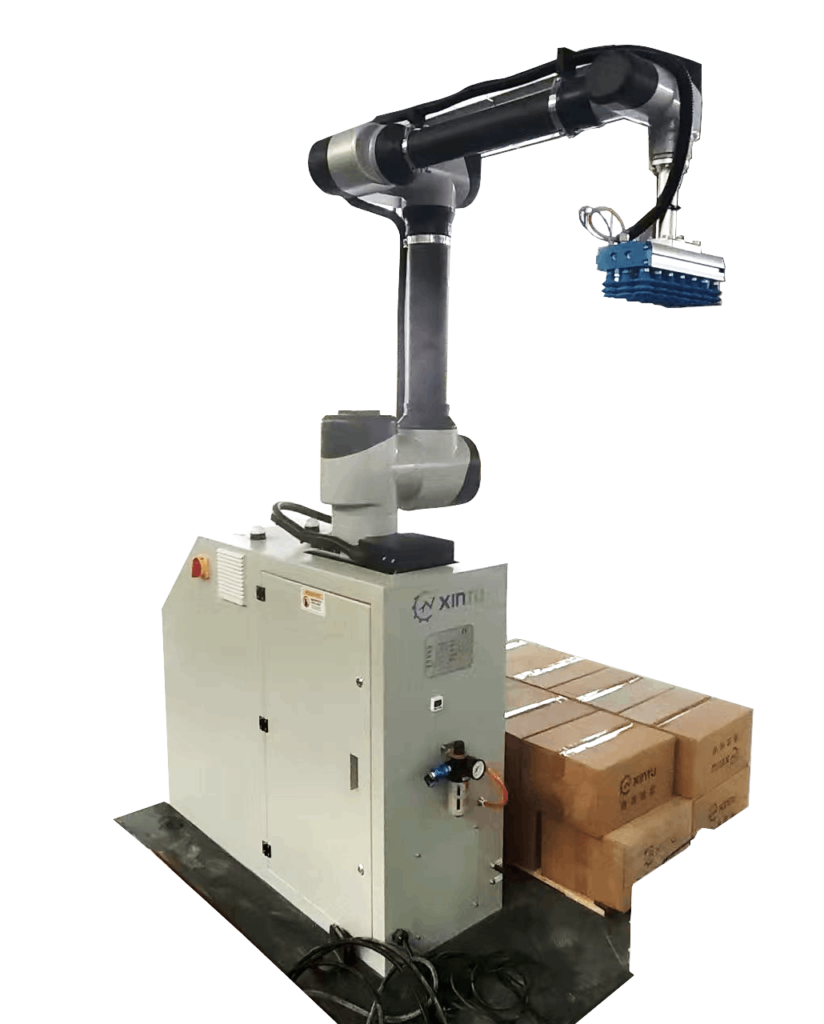
Overview of Servo Module Collaborative Robot Palletizer
Basic working principle
Collaborative robotic palletizers perform palletizing tasks by mimicking the movements of the human arm.
The process begins with an upstream conveyor line delivering boxes, bags, or cartons to designated pickup locations.
An optional built-in vision system or sensors identify the product’s position and orientation.
The collaborative robot (cobot) then uses its intelligent motion control system to precisely guide its end-effector (typically an adaptive suction cup or mechanical gripper) to grasp the product.
The robot stacks the products layer by layer onto the pallet in a stable, orderly pattern, following a pre-programmed or vision-guided pallet pattern.
This entire process is a collaborative process, eliminating the need for traditional large safety fencing.
Built-in sensors and force feedback enable the robot to automatically slow down or stop when encountering a person, significantly reducing the risk of workplace injuries and enabling human-robot collaboration.
Flexible Deployment:
Lightweight and mobile, it can be easily redeployed between production lines for a variety of tasks, such as palletizing, depalletizing, and loading and unloading materials from machine tools, providing a high return on investment.
Visual Graphical Interface:
Operators can quickly set up new tasks using a graphical interface, typically using manual guidance and teach-in, minimizing changeover time.
Cost-Effective:
Compared to traditional large-scale industrial robotic palletizing systems, it offers significantly lower deployment costs (no safety fences required) and lower operating costs (lower energy consumption).
Compact and Efficient:
With a very small footprint, its high uptime and flexibility significantly improve overall production efficiency.
Plug-and-Play
The system’s high level of integration allows for fast installation and commissioning, enabling rapid commissioning.
To get a quote, you can contact us directly via email at Mary@xintuequipment.com or fill out the contact form on our website. Provide us with your specific requirements, and we will get back to you with a detailed quote.
Lead times vary depending on the complexity and customization of the equipment. Typically, the lead time ranges from 6 to 12 weeks. We provide detailed timelines once the order is confirmed.
Yes, we offer comprehensive after-sales support, including installation, commissioning, training, maintenance, and technical assistance. Our dedicated support team ensures that your operations run smoothly.
For technical support or service, you can contact our support team via email at support@xintuequipment.com. Provide your equipment details and the issue you are experiencing, and our team will assist you promptly.
Our machines come with a standard one-year warranty covering spare parts and easy wear parts. Extended warranty options are also available upon request.
After warranty,we provide timely and low cost spare parts.
Robotic palletizers improve efficiency, reduce labor costs, enhance precision, and increase the overall productivity of your production line. They are ideal for high-volume and repetitive tasks.